Global Climate Governance: Key Agreements, Institutions and Mechanisms
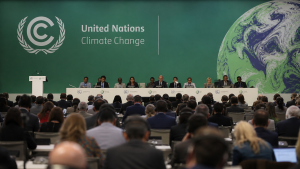
Global climate governance is built around a set of treaties, institutions and financial mechanisms that guide international action on mitigation, adaptation and support for developing countries. The system is anchored in the UNFCCC, with the Paris Agreement, Kyoto Protocol, climate finance bodies and loss-and-damage institutions forming its core architecture.
The UNFCCC and Core Climate Agreements
- UNFCCC: The United Nations Framework Convention on Climate Change was adopted at the 1992 Rio Earth Summit and entered into force in 1994. It currently has 198 Parties.
- Executive Secretary: Simon Stiell of Grenada serves as the Executive Secretary of the UNFCCC and was reappointed to a second three-year term in June 2025.
- Kyoto Protocol: Adopted in 1997 and in force from 2005, it set legally binding emission reduction targets for developed countries (Annex I Parties).
- CBDR-RC: The Kyoto Protocol operated on the principle of Common But Differentiated Responsibilities and Respective Capabilities.
- Paris Agreement: Adopted in 2015 at COP21, it has 194 Parties.
- Temperature goal: The Paris Agreement aims to keep global warming well below 2°C and preferably to 1.5°C above pre-industrial levels.
- NDCs: Countries pursue their climate targets through voluntary Nationally Determined Contributions.
The Green Climate Fund
- UNFCCC finance mechanism: The Green Climate Fund was designated as an operating entity of the UNFCCC financial mechanism at COP16 in Cancun in 2010.
- Purpose: It supports developing countries in mitigation and adaptation projects.
- Headquarters: The GCF is headquartered in Songdo, Incheon, Republic of Korea.
- Leadership: Mafalda Duarte has led the fund as Executive Director since August 2023.
- Decentralisation: In March 2026, the GCF established its first regional offices across Africa, Eastern Europe, Central Asia, the Middle East, Latin America, the Caribbean and the Pacific.
Loss and Damage Institutional Mechanisms
- Warsaw International Mechanism: The WIM was established at COP19 in 2013 to address the adverse consequences of climate change in developing countries.
- Executive Committee: Its Executive Committee is co-chaired by Ashley Codner of Jamaica and Elisa Caliari of Denmark.
- Mandate: The committee is tasked with finalising draft voluntary guidelines for data collection to inform Biennial Transparency Reports by its 25th meeting in September 2026.
- FRLD: The Fund for Responding to Loss and Damage is led by Ibrahima Cheikh Diong, who assumed office as inaugural Executive Director on November 1, 2024, for a four-year term.
- Barbados Implementation Modalities: Under the BIM pilot phase, the FRLD approved USD 250 million in start-up grant financing to be disbursed by the end of 2026.
- Funding window: The first call for funding requests, offering USD 5 million to USD 20 million to developing nations, ran from December 15, 2025, to June 15, 2026.
- Board action: At its eighth Board meeting in Livingstone, Zambia, in April 2026, the FRLD Board operationalized its country support system and direct budget support modalities.
Market Mechanisms and Carbon Trading under Article 6
- Article 6: It provides rules for voluntary cooperation to help countries meet their NDCs.
- Article 6.2: This covers bilateral or multilateral transfers of Internationally Transferred Mitigation Outcomes (ITMOs).
- Article 6.4: This creates a centralized, UN-supervised global carbon market.
- Rulebook: The operational rulebook for Paris Agreement carbon trading under Articles 6.2 and 6.4 was finalized at COP29 in Baku in November 2024.
- PACM: The UN-supervised Paris Agreement Crediting Mechanism under Article 6.4 issued its first carbon credits in February 2026.
- First credits: The first credits came from a clean-cooking project in Myanmar.
The Evolution of UNFCCC COP Summits
- COP30: It took place in Belém, Brazil, from November 10 to 21, 2025, and concluded with 56 consensus decisions.
- Finance target: COP30 set a target to mobilize USD 1.3 trillion annually by 2035 for climate action.
- Adaptation finance: It also committed to tripling climate adaptation finance by 2035.
- Just Transition: The summit officially established the Just Transition Mechanism.
- COP31: It is scheduled for November 9 to 20, 2026, in Antalya, Turkey.
- Leadership arrangement: Turkey will act as host and its Minister of Environment, Urbanization and Climate Change, Murat Kurum, will chair the summit.
- Negotiations: Australia will act as the President of Negotiations, led by Climate Change and Energy Minister Chris Bowen.
Key Prelims Takeaways
- Treaty participation: The UNFCCC has 198 Parties, while the Paris Agreement has 194 Parties.
- Kyoto legacy: The Kyoto Protocol introduced legally binding emission targets for Annex I Parties.
- Climate finance: The GCF is the key multilateral climate finance body under the UNFCCC framework.
- Loss and damage: The WIM and FRLD are the main institutional responses to climate-related loss and damage.
- Article 6: Paris Agreement carbon trading has two major channels: ITMO transfers under Article 6.2 and the UN-supervised mechanism under Article 6.4.
- PACM rollout: The first carbon credits under the Paris Agreement Crediting Mechanism were issued in February 2026.
- COP30 outcomes: COP30 produced major decisions on finance, adaptation and just transition.
Current General Studies comprises current-affairs-based, General Studies-rich study material on policies, laws, institutions, economy, science, environment, governance, international relations, and other varied but important topics for UPSC and State PSC Prelims examinations.
Fortnightly PDF compilations: Available here
Originally written on
April 12, 2026
and last modified on
September 5, 2026.
| Related | |
|---|---|