Important Self-Help Group Programmes and Institutions
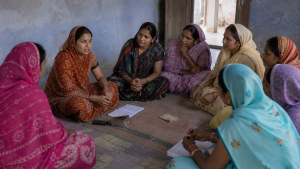
The Self-Help Group (SHG) movement in India has grown from a grassroots savings initiative into a major instrument of financial inclusion, community mobilization, and women’s empowerment.
Evolution of the Self-Help Group Movement in India
An SHG is an informal association of 10 to 25 local people, usually women, who voluntarily come together to save money and meet mutual needs.
- SEWA (1972): The origin of the SHG movement is traced to the Self-Employed Women’s Association (SEWA), established by Ela Bhatt in Gujarat to give informal women workers collective bargaining power and access to credit.
- SHG-Bank Linkage Programme (1992): NABARD launched this programme to connect informal SHGs with formal banks, enabling savings accounts and collateral-free loans.
- Swarnajayanti Gram Swarozgar Yojana (1999): The government promoted rural self-employment through SHGs, skill training, and credit-linked subsidies.
Deendayal Antyodaya Yojana – National Rural Livelihoods Mission (DAY-NRLM)
Launched in June 2011 as NRLM and later renamed DAY-NRLM, this centrally sponsored scheme aims to reduce rural poverty by building self-managed institutions of poor households.
- Target group: At least one woman from each rural poor household is to be mobilized into SHGs.
- Scale: By early 2025, more than 10 crore rural households had been mobilized into over 90 lakh SHGs.
- Financial support: The scheme provides revolving funds and community investment funds to strengthen the initial capital base of SHGs.
- Structure: It works through SHGs at the primary level, Village Organizations (VOs) at the intermediate level, and Cluster Level Federations (CLFs) at the block level.
Key Sub-schemes under DAY-NRLM
- Mahila Kisan Sashaktikaran Pariyojana (MKSP): Promotes women in agriculture and encourages sustainable farming practices.
- Start-up Village Entrepreneurship Programme (SVEP): Supports rural SHG households in setting up non-farm enterprises through business support, training, and financial assistance.
- National Rural Economic Transformation Project (NRETP): Supported by the World Bank, it promotes organic farming, value-chain development, and specialized financial services.
Lakhpati Didi Initiative
This initiative under DAY-NRLM supports women entrepreneurs in SHGs and aims to raise rural women’s incomes.
- Target: 3 crore SHG women are to be enabled to earn a sustainable annual income of at least ₹1,00,000 per household.
- Eligibility: A Lakhpati Didi should earn an average monthly income of ₹10,000 for at least four agricultural seasons or business cycles.
- Funding: There is no separate budget; the initiative uses DAY-NRLM funds and resources pooled from other government departments.
- Support measures: Digital tools, financial literacy, technical skills, and market linkages are provided to help women scale up enterprises.
Namo Drone Didi Scheme
This central sector scheme introduces advanced technology into agriculture through women-led SHGs.
- Outlay: ₹1,261 crore for 2023-24 to 2025-26.
- Coverage: 15,000 drones are to be provided to selected women SHGs for rental crop-spraying services.
- Subsidy: The central government provides an 80% subsidy on the drone and accessories, up to a maximum of ₹8 lakh.
- Loan support: The remaining cost can be covered through a loan with 3% interest subvention under the Agriculture Infrastructure Fund (AIF).
- Training: One designated SHG member receives 15-day drone pilot training, along with specialized training for a drone assistant.
Regional and State-Level Models
- Kudumbashree (Kerala): Launched in 1998, it is one of India’s largest women’s networks. It functions through a three-tier system of Neighborhood Groups (NHGs), Area Development Societies (ADS), and Community Development Societies (CDS).
- Society for Elimination of Rural Poverty (SERP): Active in Andhra Pradesh and Telangana, SERP implements the Indira Kranthi Patham programme with a focus on social mobilization, gender empowerment, and bank linkages for rural women.
- Mahila Arthik Vikas Mahamandal (MAVIM): The nodal agency for women’s development in Maharashtra, it works with financial institutions to organize women into SHGs and federations.
Key Supporting Institutions and Programmes
| Institution / Programme | Year of Establishment | Core Role and Financial Support |
| SHG-Bank Linkage Programme (SBLP) | 1992 | Led by NABARD; connects informal SHGs with formal commercial banks for savings and credit. |
| National Bank for Agriculture and Rural Development (NABARD) | 1982 | Acts as the main regulatory and development body; provides refinancing to banks lending to SHGs. |
| Small Industries Development Bank of India (SIDBI) | 1990 | Promotes micro-enterprises through the SIDBI Foundation for Micro Credit (SFMC) by providing funds to microfinance institutions. |
| Rashtriya Mahila Kosh (RMK) | 1993 | Historically provided micro-credit to intermediate organizations and NGOs for onward lending to poor women. |
- Financial access: The SHG-Bank Linkage Programme remains one of the largest microfinance initiatives in India, reaching millions of rural households.
- Livelihood shift: These institutions help move SHG members from consumption lending to production lending and sustainable micro-enterprises.
Recent Context
The Ministry of Rural Development launched the second phase of the National Campaign on Entrepreneurship-II on August 21, 2026 under DAY-NRLM. It aims to boost rural women’s enterprise, Lakhpati Didi outcomes, digital commerce access, and cadre development.
Rare Facts for Prelims
- SHGs are usually small: They generally consist of 10 to 25 members, making peer monitoring easier.
- SEWA is an old landmark: It began in 1972, much before most formal SHG programmes in India.
- NABARD’s role is central: It did not merely support SHGs; it helped institutionalize bank linkage as a model for rural credit delivery.
- Kudumbashree is multi-tiered: Its three-level structure is often cited as a model of decentralized women-led governance.
- DAY-NRLM uses federations: SHGs are not left isolated; they are linked upward to VOs and CLFs for scale and sustainability.
- Drone Didi is livelihood-linked technology: It combines agriculture, entrepreneurship, and training for women-led SHGs in one scheme.
| Related | |
|---|---|