Important Concepts in Orbital Mechanics
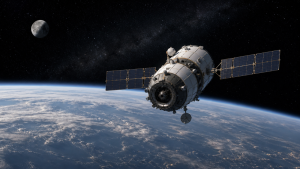
Orbital mechanics explains how rockets, satellites and spacecraft move under gravity, and how their paths, speeds and mission types are determined by classical laws of motion.
Kepler’s Laws of Planetary Motion
Johannes Kepler formulated three laws that describe the motion of planets around the Sun. These laws also apply to artificial satellites orbiting the Earth or any other celestial body.
- First Law (Law of Ellipses): All planets and satellites orbit their central body in elliptical paths, with the center of the central body located at one of the two foci. The point closest to the Earth is the perigee, and the point farthest away is the apogee. For objects orbiting the Sun, these points are perihelion and aphelion.
- Second Law (Law of Equal Areas): A line segment joining a planet and the Sun sweeps out equal areas during equal intervals of time. Consequently, a satellite travels faster when it is near perigee and slower when it is near apogee.
- Third Law (Law of Harmonies): The square of the orbital period of a planet is directly proportional to the cube of the semi-major axis of its orbit (T2 ∝ a3). This means that satellites in higher orbits take longer to complete one full revolution.
Perigee is the nearest point in orbit around Earth; apogee is the farthest.
Key Orbital Parameters (Keplerian Elements)
Six parameters, known as Keplerian elements, define the size, shape and orientation of an orbit in space, along with the position of the satellite within that orbit.
| Parameter | Symbol | Definition | Physical Meaning |
| Semi-major Axis | a | Half of the longest diameter of the elliptical orbit. | Establishes the size of the orbit and the orbital period. |
| Eccentricity | e | The ratio of the distance between the foci to the length of the major axis. | Dictates the shape of the orbit, ranging from 0 (circular) to values between 0 and 1 (elliptical). |
| Inclination | i | The angle between the orbital plane and the reference plane (usually the equator). | Dictates the tilt of the orbit relative to the equator. |
| Longitude of the Ascending Node | Ω | The angle from a reference direction (vernal equinox) to the point where the orbit crosses the equator from south to north. | Dictates the horizontal orientation of the orbital plane in space. |
| Argument of Periapsis | ω | The angle from the ascending node to the closest point of approach (perigee). | Dictates the orientation of the ellipse within the orbital plane. |
| True Anomaly | ν or θ | The angle between the perigee and the satellite’s current position, measured from the primary focus. | Marks the current position of the satellite along its orbit. |
Crucial Velocities in Orbital Mechanics
Two primary velocities determine whether an object will orbit or escape a celestial body.
- Orbital Velocity: This is the speed required to maintain a stable circular orbit at a specific altitude. The formula is v = √(GM/r), where G is the gravitational constant, M is the mass of the primary body and r is the distance from the center of the primary body. In Low Earth Orbit, this speed is approximately 7.8 kilometres per second.
- Escape Velocity: This is the minimum speed an unpropelled body needs to escape the gravitational pull of a primary body and enter a parabolic trajectory. The formula is ve = √(2GM/r). For Earth, the escape velocity at the surface is approximately 11.2 kilometres per second.
Low Earth Orbit speed is about 7.8 km/s, while Earth’s escape velocity is about 11.2 km/s.
Classifications of Earth Orbits
Earth orbits are classified based on altitude, inclination and orbital period. Different altitudes serve distinct scientific, commercial and military purposes.
Low Earth Orbit (LEO)
- Altitude: 160 kilometres to 2,000 kilometres above Earth’s surface.
- Orbital Period: 90 to 120 minutes.
- Key Characteristics: High velocity is required to overcome gravity. Satellites in LEO experience atmospheric drag from the upper atmosphere, causing orbital decay over time.
- Applications: International Space Station (ISS), Earth observation satellites, Hubble Space Telescope and large communication constellations like Starlink.
Medium Earth Orbit (MEO)
- Altitude: 2,000 kilometres to 35,786 kilometres.
- Orbital Period: 2 to 24 hours (most commonly 12 hours).
- Key Characteristics: This region sits between LEO and GEO. It contains the Van Allen radiation belts, which can damage unprotected satellite electronics.
- Applications: Global Navigation Satellite Systems (GNSS) such as the US GPS, Russian GLONASS, European Galileo and Chinese BeiDou.
Geosynchronous (GSO) and Geostationary Orbit (GEO)
- Altitude: Exactly 35,786 kilometres.
- Orbital Period: 23 hours, 56 minutes, 4 seconds (one sidereal day).
- Key Characteristics: Satellites in GEO circle the Earth at the exact speed of Earth’s rotation. GEO is a circular orbit directly above the equator with an inclination of zero degrees. GSO can be inclined, causing the satellite to trace a figure-eight path in the sky.
- Applications: Weather observation, communication satellites and direct-to-home television broadcasting.
Polar and Sun-Synchronous Orbits (SSO)
- Polar Orbit: Satellites pass over or near both poles on every revolution, with an inclination close to 90 degrees. This allows the satellite to eventually scan the entire surface of the Earth as the planet rotates beneath it.
- Sun-Synchronous Orbit (SSO): A special polar orbit where the satellite precesses at the exact rate of Earth’s orbit around the Sun (about 0.9856 degrees per day). Consequently, the satellite passes over any given location at the exact same local solar time. This ensures consistent lighting conditions for photography and remote sensing.
Special and Advanced Orbits
Engineers design specific orbital paths to solve regional coverage issues or manage space debris.
Highly Elliptical Orbits (HEO)
- Molniya Orbit: This orbit has a 12-hour period and an inclination of 63.4 degrees. This specific inclination halts the rotation of the perigee caused by Earth’s oblateness. The high eccentricity allows satellites to spend up to 8 hours of their 12-hour cycle over high-latitude areas. Russia uses this orbit for northern communications.
- Tundra Orbit: This orbit is similar to the Molniya orbit but operates with a 24-hour period, providing continuous high-latitude coverage with fewer satellites.
Graveyard Orbit
- Altitude: Located roughly 300 kilometres above the Geostationary Orbit (GEO).
- Purpose: Active satellites near the end of their operational lifespan are maneuvered into this orbit using their remaining fuel. Moving them here prevents collision risks and frees up active slots in the crowded GEO belt.
Lagrange Points (L-Points)
Lagrange points are positions in space where the gravitational forces of a two-body system, like the Sun and Earth, produce enhanced regions of attraction and repulsion. Spacecraft use these positions to maintain a stable location with minimal fuel consumption.
- L1: Positioned between the Sun and Earth. It provides an uninterrupted view of the Sun. India’s Aditya-L1 and the Solar and Heliospheric Observatory (SOHO) are placed here.
- L2: Positioned directly behind the Earth relative to the Sun. It is cold and shielded from solar radiation, making it ideal for deep-space observatories like the James Webb Space Telescope (JWST).
- L3: Positioned on the opposite side of the Sun, hidden behind it relative to Earth.
- L4 and L5: Positioned 60 degrees ahead and 60 degrees behind the Earth in its orbital path. These are stable points where space dust and asteroids, known as Trojan asteroids, naturally accumulate.
Orbital Maneuvers
Satellites use orbital maneuvers to change their orbit, match orbits with other spacecraft or depart for other planets.
- Hohmann Transfer Orbit: This is an orbital transfer that moves a spacecraft between two coplanar circular orbits of different altitudes. It uses two engine burns: one to enter the elliptical transfer orbit and another to circularize the orbit at the target altitude. This is the most fuel-efficient method for standard orbit transfers.
- Bi-elliptic Transfer: This transfer utilizes three engine burns and an intermediate highly elliptical orbit. It is more fuel-efficient than a Hohmann transfer if the ratio of the final orbit radius to the initial orbit radius is greater than 11.94.
- Gravity Assist (Slingshot Effect): Spacecraft utilize the gravity and orbital velocity of a planet to alter their path and speed. This technique saves chemical propellant. Famous missions like Voyager 1, Voyager 2 and Cassini used gravity assists to reach the outer solar system.
Rare Facts for Prelims
- Sidereal day: A geostationary satellite matches Earth’s sidereal day, not the 24-hour solar day.
- GEO belt: Only equatorial satellites can remain fixed over one point on Earth’s surface.
- Molniya advantage: The 63.4-degree inclination reduces long-term drift of the orbit’s perigee.
- Trojan asteroids: These bodies cluster near L4 and L5 because those points are gravitationally stable.
- Bi-elliptic transfer: It becomes more efficient than Hohmann transfer only for large orbit changes.
- Frame dragging: A rotating massive body can slightly drag spacetime around it, affecting nearby orbits.
| Related | |
|---|---|