Major Government Digital Initiatives in India
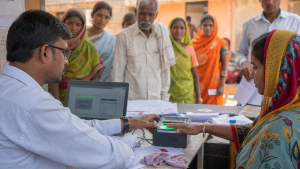
India’s digital governance model rests on a mix of identity infrastructure, payment rails, service delivery platforms and broadband expansion. These initiatives are designed to improve public service access, support financial inclusion and make government systems more efficient and transparent.
Core Digital Public Infrastructure
- Aadhaar: It provides a 12-digit unique identity number to residents based on biometric and demographic data collected by the Unique Identification Authority of India (UIDAI).
- Use of Aadhaar: It enables paperless and cashless authentication across digital networks and supports electronic Know-Your-Customer (e-KYC) processes.
- Welfare delivery: Aadhaar is widely used for digital signature verification and targeted delivery of public subsidies and benefits.
- UIDAI: The Unique Identification Authority of India was established under the statutory provisions of the Aadhaar Act, 2016.
- India Stack: It is a unified set of open application programming interfaces (APIs) that enables identity, data and payment interoperability.
- Unified Payments Interface (UPI): Developed by the National Payments Corporation of India, it is an instant real-time payment system.
- UPI functionality: It allows users to link multiple bank accounts in a single mobile application for peer-to-peer and peer-to-merchant transactions.
Digital India and E-Governance
- Digital India Programme: It aims to transform India into a digitally empowered society through digital infrastructure, service delivery on demand and digital literacy.
- Integration of services: The programme brings together disparate government platforms into unified portals to streamline administrative workflows and citizen interaction.
- Digital payments: It promotes electronic payments as a routine mode of public and private transactions.
- Digital Locker: DigiLocker provides secure cloud-based storage for issuing, verifying and sharing authentic documents and certificates.
- Government e-Marketplace (GeM): It is a transparent online public procurement portal for central and state government ministries and departments.
- Common Service Centers (CSCs): They function as physical access points for delivering essential digital services in rural and remote areas.
- National e-Governance Plan: It was approved by the central government in May 2006.
Broadband and Rural Connectivity
- BharatNet Project: It connects Gram Panchayats with high-speed optical fibre networks to reduce the rural-urban digital divide.
- Implementing agency: Bharat Broadband Network Limited executes the BharatNet project under the Department of Telecommunications.
- Funding: Financing for the initiative is managed through the Digital Bharat Nidhi.
- Significance: The project is a key part of India’s digital public infrastructure because it extends connectivity to the village level.
Public Wi-Fi and Digital Access
- PM-WANI: The Prime Minister Wi-Fi Access Network Interface promotes public Wi-Fi hotspots through small retail shops and local establishments.
- Public Data Offices: The framework removes licensing fees and registration requirements for Public Data Offices to encourage grassroots participation.
- Centre for Development of Telematics (C-DOT): It maintains the central registry for authenticating network providers and applications.
- C-DOT background: The Centre for Development of Telematics was established in 1984 as an autonomous telecom research and development centre.
Institutional Framework
| Initiative | Primary Objective | Implementing Agency |
| Aadhaar | Providing a unique biometric identifier for residents | Unique Identification Authority of India |
| BharatNet | Connecting rural Gram Panchayats with optical fibre | Bharat Broadband Network Limited |
| DigiLocker | Providing secure cloud storage for official documents | Ministry of Electronics and Information Technology |
| Government e-Marketplace | Ensuring transparent public procurement of goods and services | Directorate General of Supplies and Disposals |
Why These Initiatives Matter
- Financial inclusion: Aadhaar, UPI and digital service platforms support access to banking and formal payments.
- Service delivery: DigiLocker, CSCs and unified portals reduce paperwork and improve citizen access to services.
- Transparency: GeM and digital authentication systems help reduce discretion and improve traceability.
- Connectivity: BharatNet and PM-WANI expand internet access beyond urban centres.
- Digital governance: The overall ecosystem links identity, payments, connectivity and procurement into a single policy framework.
Key Prelims Takeaways
- Aadhaar is a 12-digit unique identity number issued by UIDAI under the Aadhaar Act, 2016.
- UPI is an instant real-time payment system developed by the National Payments Corporation of India.
- India Stack refers to open APIs for identity, data and payment interoperability.
- Digital India focuses on digital infrastructure, service delivery on demand and digital literacy.
- DigiLocker is a secure cloud platform for storing and sharing verified documents.
- GeM is the online public procurement platform for government departments and ministries.
- BharatNet aims to connect Gram Panchayats with optical fibre, while PM-WANI expands public Wi-Fi access.
Current General Studies comprises current-affairs-based, General Studies-rich study material on policies, laws, institutions, economy, science, environment, governance, international relations, and other varied but important topics for UPSC and State PSC Prelims examinations.
Fortnightly PDF compilations: Available here
Originally written on
June 6, 2026
and last modified on
September 6, 2026.
| Related | |
|---|---|