Medical Education in India: Courses, Admissions and Clinical Training
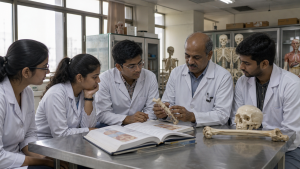
Medical education in India combines regulated academic programmes, competitive entrance examinations and supervised clinical experience. Its framework covers undergraduate, postgraduate and super-specialty training, while teaching hospitals and institutional standards support practical learning and the preparation of healthcare professionals.
Regulatory Framework: National Medical Commission
The National Medical Commission Act, 2019, provides the national framework for regulating medical education and medical institutions. The National Medical Commission (NMC), established under the Act, replaced the Medical Council of India (MCI) in 2020. The NMC sets standards for medical education, recognises medical qualifications, provides for the registration of medical practitioners and regulates medical institutions. Its stated objectives include improving access to quality and affordable medical education, maintaining professional standards and strengthening grievance redressal. The Commission has four autonomous boards:
- Undergraduate Medical Education Board (UGMEB): Oversees undergraduate medical education.
- Postgraduate Medical Education Board (PGMEB): Oversees postgraduate medical education.
- Medical Assessment and Rating Board (MARB): Assesses and rates medical institutions.
- Ethics and Medical Registration Board (EMRB): Deals with medical ethics and registration.
Medical Courses and Structure
Medical training is organised into undergraduate, postgraduate and super-specialty stages. The programmes differ in duration and level of specialisation.
- Undergraduate courses: The Bachelor of Medicine, Bachelor of Surgery (MBBS) is the principal undergraduate medical degree. It generally takes five and a half years, including a compulsory one-year rotating internship. Other undergraduate courses include Bachelor of Dental Surgery (BDS), Bachelor of Ayurvedic Medicine and Surgery (BAMS), Bachelor of Homeopathic Medicine and Surgery (BHMS) and Bachelor of Unani Medicine and Surgery (BUMS).
- Postgraduate courses: After MBBS, doctors may pursue a Doctor of Medicine (MD) or Master of Surgery (MS). These are generally three-year programmes that provide training in a specialty such as General Medicine, Surgery, Pediatrics, Obstetrics and Gynecology, or Radiology.
- Super-specialty courses: Doctorate of Medicine (DM) and Master of Chirurgiae (MCh) programmes provide further specialisation, usually after MD or MS. They generally last three years and include fields such as Cardiology, Neurology, Urology and Neurosurgery.
Admission Process
Admission to medical courses is primarily based on national-level entrance examinations. Candidates who qualify must also participate in the relevant counselling process for seat allocation.
- NEET-UG: The National Eligibility cum Entrance Test (NEET-UG), conducted by the National Testing Agency (NTA), is the common entrance examination for undergraduate medical courses. It applies to MBBS, BDS, BAMS, BHMS and BUMS admissions, including at AIIMS and JIPMER. Qualification is required to take part in counselling for government and private college seats.
- NEET-PG: The National Eligibility cum Entrance Test for Postgraduate (NEET-PG) is the entrance examination for MD, MS and postgraduate diploma courses. It is conducted by the National Board of Examinations in Medical Sciences (NBEMS).
- NEET-SS: The NEET Super Specialty examination is used for admission to DM and MCh courses.
- Counselling: The Medical Counselling Committee (MCC) conducts counselling for All India Quota seats. State authorities conduct counselling for state quota seats.
Clinical Training and Institutional Infrastructure
Clinical exposure is an integral part of medical education. Medical colleges are affiliated with functional hospitals where students learn to observe and participate in patient care under supervision. The compulsory MBBS internship follows the academic years of the course. Interns rotate through departments including Medicine, Surgery, Pediatrics, Obstetrics and Gynecology, and Community Medicine. This provides practical experience in diagnosis, treatment and patient management. Recognised colleges require facilities such as laboratories, lecture halls, dissection halls and libraries, alongside medical equipment and an attached teaching hospital. NMC regulations set requirements concerning faculty-student ratios, hospital bed strength and other essential facilities. Clinical training standards therefore depend on both adequate institutional capacity and suitable supervised practice.
System Priorities
Medical education policy has to balance the expansion of training capacity with access to affordable education and consistent clinical standards. More training capacity can support the development of the medical workforce, while access depends on the availability of seats and institutions. Teaching hospitals, facilities and supervised internships remain important to ensuring that expansion is matched by practical training.
Key Prelims Takeaways
- The National Medical Commission Act was enacted in 2019.
- The NMC replaced the Medical Council of India in 2020.
- NEET-UG is the common entrance examination for undergraduate medical courses.
- MBBS generally takes five and a half years, including a one-year compulsory rotating internship.
- MD and MS courses generally last three years; DM and MCh courses are generally three-year super-specialty programmes.
- NBEMS conducts NEET-PG and NEET-SS.
Recent Context
On 19 October 2026, the Union Ministry of Health and Family Welfare approved operationalisation of Ladakh’s first Government Medical College in Leh. A one-time relaxation allows staggered recruitment against 103 sanctioned posts before 80% of the infrastructure is complete. SNM Hospital, a 200-bedded facility, is designated for clinical training.
| Related | |
|---|---|