Major Public Health Institutions and Healthcare Infrastructure in India
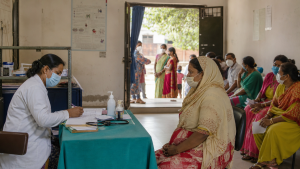
India’s healthcare system combines primary, secondary and tertiary services with national institutions responsible for policy, regulation and research. Its public health framework is shaped by the division of constitutional responsibilities, national programmes and efforts to expand medical education and healthcare access across regions.
Healthcare Delivery System
India’s healthcare delivery system is organised into three tiers, linking community-level services with specialist and advanced care.
- Primary healthcare: The first point of contact, delivered through Health and Wellness Centres (HWCs), including Sub-Centres and Primary Health Centres (PHCs), particularly in rural areas. Services include preventive, promotive, curative and rehabilitative care, with emphasis on maternal and child health, immunisation, nutrition and common ailments.
- Secondary healthcare: Community Health Centres (CHCs) and District Hospitals provide more specialised care. They offer services such as basic surgery, X-rays, laboratory investigations and specialist consultations.
- Tertiary healthcare: Medical colleges and advanced research institutions provide highly specialised diagnosis and treatment. All India Institutes of Medical Sciences (AIIMS) are major institutions combining advanced patient care, medical education and research.
Constitutional Framework and Institutions
Public health and sanitation are primarily State subjects under the Seventh Schedule of the Constitution. Population control and family planning are on the Concurrent List, enabling both Union and State governments to legislate. The Ministry of Health and Family Welfare (MoHFW) is the central ministry responsible for health policy and national programmes.
- MoHFW: Comprises the Department of Health & Family Welfare and the Department of Health Research. It oversees initiatives including the National Health Mission and Ayushman Bharat.
- National Medical Commission (NMC): The NMC Act, 2019, replaced the Indian Medical Council Act, 1956. The NMC became operational on September 25, 2020, replacing the Medical Council of India (MCI). It regulates medical education and institutions, recognises medical qualifications and provides for accreditation of medical schools.
- NMC’s autonomous boards: These are the Under-Graduate Medical Education Board, Post-Graduate Medical Education Board, Medical Assessment and Rating Board, and Ethics and Medical Registration Board.
- AIIMS: These autonomous government public medical universities are declared Institutes of National Importance by an Act of Parliament. AIIMS Delhi was established in 1956. New AIIMS are being developed under the Pradhan Mantri Swasthya Suraksha Yojana (PMSSY).
- Indian Council of Medical Research (ICMR): India’s apex body for formulating, coordinating and promoting biomedical research. Established in 1911 as the Indian Research Fund Association, it was renamed ICMR in 1949. It operates under MoHFW and generates evidence relevant to public health policy.
- National Centre for Disease Control (NCDC): The national institute for surveillance, prevention and control of communicable and non-communicable diseases. Its origins lie in the Central Malaria Bureau, established in Kasauli in 1909. It is the nodal agency for disease outbreak investigation and rapid response.
- Central Drugs Standard Control Organization (CDSCO): India’s national regulatory authority for pharmaceuticals and medical devices. Its responsibilities include approving new drugs, conducting clinical trials and maintaining drug quality control.
National Health Programmes and Initiatives
- National Health Mission (NHM): Launched in 2013, it subsumed the National Rural Health Mission (NRHM), launched in 2005, and the National Urban Health Mission (NUHM), launched in 2013. It aims to provide universal access to equitable, affordable and quality healthcare. Its components include health-system strengthening, Reproductive-Maternal-Neonatal-Child and Adolescent Health (RMNCH+A), and control of communicable and non-communicable diseases.
- Ayushman Bharat: Launched in 2018 as an initiative towards Universal Health Coverage, it has two main pillars:
- Pradhan Mantri Jan Arogya Yojana (AB-PMJAY): Launched on September 23, 2018, it provides health assurance of up to Rs 5 lakh per family per year for secondary and tertiary hospitalisation. There is no cap on family size, age or gender. Beneficiaries are identified using the Socio Economic Caste Census (SECC) of 2011.
- Ayushman Bharat Digital Mission (ABDM): Launched on September 27, 2021, it aims to develop an integrated digital health infrastructure. Its components include the 14-digit Ayushman Bharat Health Account (ABHA) number, the Health Facility Registry and the Healthcare Professionals Registry.
- PMSSY: Seeks to address regional imbalances in access to affordable and reliable tertiary healthcare and strengthen quality medical education. It supports the establishment of new AIIMS and the upgrading of existing government medical colleges.
Medical Education and Allied Professions
- NEET-UG: The National Eligibility cum Entrance Test is the common entrance examination for undergraduate medical courses in India.
- National Exit Test (NExT): The NMC Act, 2019, provides the national statutory framework for NEET and NExT.
- Allied and healthcare professions: The National Commission for Allied and Healthcare Professions Act, 2021 (NCAHPA), provides for regulation and standardisation of education and practice. It covers 57 professions across 10 recognised categories and defines allied health and healthcare professionals with specific educational requirements.
Key Prelims Takeaways
- Public health and sanitation are State subjects; population control and family planning are on the Concurrent List.
- MoHFW comprises the Departments of Health & Family Welfare and Health Research.
- The NMC replaced the MCI in 2020 under the NMC Act, 2019.
- ICMR traces its origin to the Indian Research Fund Association, established in 1911; it was renamed in 1949.
- NCDC’s institutional origins date to the Central Malaria Bureau of 1909.
- NHM, launched in 2013, subsumed NRHM and NUHM.
- AB-PMJAY offers up to Rs 5 lakh per family per year for secondary and tertiary hospitalisation; NEET-UG is the common undergraduate medical entrance test.
Recent Context
On October 19, 2026, MoHFW approved operationalisation of Ladakh’s first Government Medical College in Leh, scheduled to begin in 2027–28. A one-time relaxation allows staggered recruitment against 103 regular posts before 80% of infrastructure is complete. Two new buildings will house the Academic Block and Students’ Hostel; the 200-bedded Sonam Norboo Memorial Hospital will provide clinical training.
| Related | |
|---|---|