India’s Broadband Initiatives and Schemes
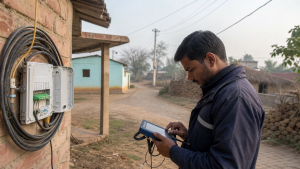
India’s broadband push combines large-scale fibre rollout, public Wi-Fi expansion, and legal-regulatory reforms to improve digital access across urban, rural, remote, and island regions. The focus is on last-mile connectivity, affordable internet, and infrastructure that can support e-governance, education, and economic activity.
Core Broadband Infrastructure
- BharatNet: One of the world’s largest rural telecom projects, aimed at connecting all Gram Panchayats with high-speed optical fibre networks.
- Implementing agency: Bharat Broadband Network Limited (BBNL), a special purpose vehicle under the Department of Telecommunications.
- Funding mechanism: The project is financed through Digital Bharat Nidhi, earlier known as the Universal Service Obligation Fund.
- Network design: The amended programme uses an IP-MPLS ring-based architecture to improve redundancy, reliability, and scalability.
- Use cases: The network is intended to support local e-governance, e-education, and other digital public services.
- Legal framework: The Telecommunications Act, 2023 modernises the framework for spectrum assignment and telecom infrastructure deployment.
National Broadband Mission
- Objective: To operationalise broadband for all by creating universal, affordable, and high-quality digital communications infrastructure.
- Digital fibre map: The mission seeks to build a comprehensive fibre map of the country by integrating optical fibre cables and telecom towers.
- Right of Way: It works with states and union territories to streamline approvals and speed up infrastructure rollout.
- Monitoring: Implementation is tracked through a dedicated Broadband Readiness Index across states and union territories.
- Coverage focus: The mission supports tower fiberisation and wider broadband expansion through coordinated public and private effort.
Public Wi-Fi and Last-Mile Access
- PM-WANI: The Prime Minister Wi-Fi Access Network Interface promotes public Wi-Fi hotspots through small retail shops and local establishments.
- Low entry barriers: The framework removes licensing fees, registration requirements, and regulatory dues for Public Data Offices.
- Entrepreneurship model: It is designed to encourage grassroots digital entrepreneurship and expand access at the neighbourhood level.
- Four-layer ecosystem: The framework consists of Public Data Offices, Public Data Office Aggregators, App Providers, and a Central Registry.
- Registry role: The Centre for Development of Telematics maintains the Central Registry to authenticate network providers and applications.
- Business model: The system is meant to be market-led and self-sustainable rather than subsidy-heavy.
Special Regional and Submarine Projects
- Comprehensive Telecom Development Plan: It targets mobile and broadband coverage in remote, border, Left Wing Extremism-affected, and aspirational districts.
- Island connectivity: Submarine optical fibre cable projects connect mainland India with island territories.
- Key links: Important examples include the Chennai-Andaman and Nicobar Islands link and the Kochi-Lakshadweep connection.
- Satellite support: The plan also integrates satellite communication media through collaboration with the Department of Space for inaccessible terrain.
- Strategic significance: These projects are vital for regions where conventional terrestrial telecom infrastructure is difficult to deploy.
Institutions and Legal Milestones
- Bharat Broadband Network Limited: Incorporated in 2012 under the Companies Act.
- Centre for Development of Telematics: Established in 1984 as an autonomous telecom research and development centre.
- Payment and Settlement Systems Act: Enacted in 2007.
- Digital Bharat Nidhi: The renamed funding pool for universal service obligations in telecom.
- Telecommunications Act, 2023: Relevant for the broader telecom policy and infrastructure environment.
| Scheme / Initiative | Implementing Agency | Primary Objective | Funding / Mechanism |
| BharatNet | Bharat Broadband Network Limited | Optical fibre connectivity for Gram Panchayats | Digital Bharat Nidhi |
| National Broadband Mission | Department of Telecommunications | Universal high-speed broadband and tower fibreisation | Public-private partnerships and central outlays |
| PM-WANI | Centre for Development of Telematics | Expansion of public Wi-Fi hotspots through small micro-entrepreneurs | Market-led self-sustainable model |
Key Prelims Takeaways
- BharatNet is a rural broadband project connecting Gram Panchayats through optical fibre.
- BBNL is the special purpose vehicle under the Department of Telecommunications for BharatNet.
- Digital Bharat Nidhi is the renamed form of the Universal Service Obligation Fund.
- National Broadband Mission focuses on universal, affordable, high-quality broadband infrastructure.
- PM-WANI promotes public Wi-Fi through small shops and local outlets without licensing fees for Public Data Offices.
- CDOT maintains the central registry for PM-WANI authentication.
- Submarine cable links are important for mainland connectivity with Andaman and Nicobar Islands and Lakshadweep.
Current General Studies comprises current-affairs-based, General Studies-rich study material on policies, laws, institutions, economy, science, environment, governance, international relations, and other varied but important topics for UPSC and State PSC Prelims examinations.
Fortnightly PDF compilations: Available here
Originally written on
June 3, 2026
and last modified on
September 6, 2026.
| Related | |
|---|---|