
Major Dynasties of Karnataka
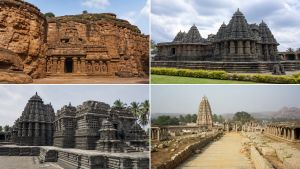
The medieval history of Karnataka was shaped by powerful dynasties that influenced administration, temple architecture, literature, and trade across the Deccan and southern India. Among the most important were the Chalukyas of Badami, Rashtrakutas of Manyakheta, Hoysalas of Halebidu, and the Vijayanagara Empire.
These ruling houses not only expanded territorial power but also left durable marks on Kannada culture, statecraft, and religious patronage. Their legacy is visible in inscriptions, temple complexes, and literary works that remain central to Prelims revision.
Chalukyas of Badami
The Chalukyas of Badami ruled the Deccan from the sixth to eighth century CE and helped bridge northern and southern political traditions. Their capital was Badami, ancient Vatapi, which became a major centre of power and architecture.
- Founder: Pulakeshin I fortified Badami and established it as the capital.
- Peak ruler: Pulakeshin II is remembered for halting Harshavardhana’s northward expansion on the banks of the Narmada River in 618 CE.
- Last ruler: Kirtivarman II was overthrown by the Rashtrakutas in the mid-eighth century.
- Administration: The system was centralized, with provincial governors appointed directly by the king.
- Language and records: Kannada and Sanskrit received royal patronage, and stone inscriptions served as key administrative records.
- Architecture: Cave architecture flourished at Badami, especially rock-cut Hindu and Jain shrines with detailed relief sculpture.
Rashtrakutas of Manyakheta
The Rashtrakutas rose in the mid-eighth century and controlled much of the Deccan plateau from Manyakheta until the tenth century. They became one of the most powerful imperial dynasties of early medieval India.
- Founder: Dantidurga established the imperial line after defeating the Chalukyas of Badami.
- Legitimacy: He performed the hiranya-garbha sacrifice at Ujjain.
- Expansions: Dhruva Dharavarsha defeated both the Gurjara-Pratiharas and the Palas in the tripartite struggle.
- Long reign: Amoghavarsha I ruled for over six decades.
- Literary contribution: He authored Kavirajamarga, the earliest extant work on Kannada poetics.
- Administrative divisions: The empire was divided into rashtras or mandalam, governed by rashtrapatis.
- Religious patronage: Jainism received strong support alongside Shaivism and Vaishnavism.
- Architecture: Rock-cut architecture reached its peak with the Kailasa Temple at Ellora under Krishna I.
Exam fact: The Kailasa Temple at Ellora is carved vertically out of a single rock cliff and is considered a masterpiece of Rashtrakuta engineering.
Hoysalas of Halebidu
The Hoysalas emerged first as chieftains and later built an independent kingdom in the southern Deccan during the eleventh and twelfth centuries. Their rule is especially important for its temple architecture and regional consolidation.
- First major independent ruler: Vishnuvardhana captured Talakad from the Cholas.
- Religious shift: He embraced Vaishnavism under the influence of Ramanujacharya.
- Imperial phase: Veera Ballala II liberated the kingdom from Western Chalukya hegemony and assumed the title Chakravartin.
- Last powerful monarch: Veera Ballala III fought against the territorial expansion of the Delhi Sultanate.
- Local administration: Village assemblies and autonomous guilds handled local affairs.
- Building material: Soapstone allowed artisans to carve highly detailed ornamental work.
- Architectural hallmark: Star-shaped temple plans became the standard Hoysala feature.
- Decorative style: Temples included bracket figures, friezes, and finely polished surfaces.
Vijayanagara Empire
The Vijayanagara Empire dominated South India from the fourteenth to seventeenth century and acted as a major political and cultural bulwark in the region. It became famous for strong military power, temple-building, and support for literature.
- Founders: Harihara I and Bukka Raya I established the empire in 1336 CE on the southern banks of the Tungabhadra River under the guidance of Vidyaranya.
- Golden age: Krishna Deva Raya brought the empire to its peak in the sixteenth century.
- Military record: He defeated regional sultans and maintained maritime trade with the Portuguese.
- Fall of power: Aliya Rama Raya was defeated at the Battle of Talikota in 1365 CE, after which the capital was sacked.
- Administration: The empire was divided into mandalams, headed by governors known as nayankaras.
- Literature: Telugu, Kannada, and Sanskrit literature flourished under royal patronage.
- Court culture: Literary collectives such as the Ashtadiggajas were associated with the court.
- Architecture: Monumental granite temples, towering gopurams, and musical pillars became characteristic features.
Comparative Overview of Karnataka Dynasties
| Dynasty | Capital | Founder | Peak Ruler | Primary Architectural Style |
| Chalukyas | Badami | Pulakeshin I | Pulakeshin II | Rock-cut cave temples and early Vesara style |
| Rashtrakutas | Manyakheta | Dantidurga | Amoghavarsha I | Monolithic rock-cut architecture at Ellora |
| Hoysalas | Belur and Halebidu | Nripa Kama II | Vishnuvardhana | Stellate plan soapstone temples |
| Vijayanagara | Vijayanagara | Harihara I and Bukka Raya I | Krishna Deva Raya | Massive stone gopurams and pillared mandapas |
Key Historical Facts
- Aihole Inscription: Composed by the court poet Ravikirti, it records Pulakeshin II’s campaigns against Harshavardhana.
- Kavirajamarga: It identifies the geographical expanse of the Kannada-speaking region from the Cauvery River to the Godavari River.
- Battle of Takkolam, 949 CE: The Rashtrakutas under Krishna III defeated the Chola army and captured northern Tamil Nadu.
- Hoysala temples: The Chennakeshava Temple at Belur is noted for lathe-turned pillars with a metallic sheen.
- Vijayanagara accounts: Niccolo de Conti, Abdur Razzak, and Domingo Paes described the capital’s irrigation network and market economy.
- Virupaksha Temple, Hampi: It preserves earlier Chalukya elements that were expanded during the Vijayanagara period.
- Architectural continuity: Karnataka’s dynasties repeatedly combined temple patronage with political legitimacy and regional identity.
Key Prelims Takeaways
- Chalukyas of Badami were centred at Vatapi/Badami and are associated with Pulakeshin II.
- Rashtrakutas rose after defeating the Chalukyas and made Manyakheta their capital.
- Amoghavarsha I is important for Kavirajamarga, the earliest extant Kannada poetics text.
- Hoysalas are best identified by soapstone temples and star-shaped plans.
- Vijayanagara was founded in 1336 CE by Harihara I and Bukka Raya I.
- Krishna Deva Raya marks the golden age of Vijayanagara.
- Kailasa Temple at Ellora is a key Rashtrakuta monument carved from a single rock.
| Related | |
|---|---|


likithkumar
August 25, 2018 at 10:47 pmmore telangana movement mcs