Timeline of Kannada Literature
Timeline of Kannada Literature
Kannada literature spans more than a thousand years and reflects the changing religious, social and political life of Karnataka. Its history moves from Old Kannada inscriptions and Jain court poetry to the Vachana movement, and then to modern experimentation in fiction, poetry and criticism.
The literary tradition also mirrors the evolution of the language itself—from Halegannada to Nadugannada and finally Hosagannada. For Prelims, the key names, genres and milestone texts are as important as the broad phases.
Early Kannada Literature and Halegannada
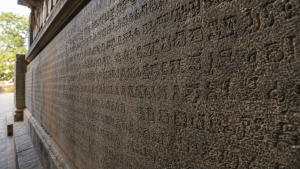
- Halmidi Inscription: Dated to around 450 CE, it is regarded as the earliest known complete stone inscription in Kannada script and language.
- Kavirajamarga: Written by Rashtrakuta king Amoghavarsha I in the ninth century, it is the earliest extant work on Kannada poetics and grammar.
- Language status: Halegannada or Old Kannada formed the base of early literary expression and preserved many archaic forms later studied by linguists.
- Kavirajamarga’s territorial reference: It mentions the Kannada-speaking region extending from the Cauvery in the south to the Godavari in the north.
- Vaddaradhane: Authored by Shivakotiacharya in the tenth century, it is considered the earliest surviving prose work in Kannada and contains Jain tales.
- Literary context: Early Kannada writing grew in an environment shaped by Jainism, Shaivism and royal patronage.
Pampa and the Champu Tradition
- Adikavi Pampa: One of the greatest early Kannada poets, he helped establish the champu tradition, which blends verse and prose.
- Adi Purana: Pampa’s tenth-century Jain epic is an important example of champu style.
- Vikramarjuna Vijaya: Also by Pampa, this work relates the Mahabharata story while glorifying his patron king Arikesari II.
- Ranna: A major tenth-century poet who continued the classical epic tradition in Kannada.
- Gada Yuddha: Ranna’s epic focuses on the final duel between Duryodhana and Bhima in the Mahabharata.
- Classical importance: Pampa, Ranna and Ponna are central to the early courtly phase of Kannada literature.
Vachana Movement and Hoysala Age
- Vachana Sahitya: This form of short, direct socio-religious prose-poetry became a powerful medium of reform in the twelfth century.
- Basaveshwara: He popularized the Vachanas and opposed caste hierarchy and ritualism through simple Kannada expression.
- Anubhava Mantapa: Established at Kalyana, it functioned as a spiritual parliament where people from different backgrounds composed and discussed Vachanas.
- Akka Mahadevi: A prominent Veerashaiva mystic whose Vachanas were addressed to Chenna Mallikarjuna.
- Allama Prabhu: Known for philosophical and mystical Vachanas that questioned orthodox ritual practices.
- Shabdamanidarpana: Kesiraja’s thirteenth-century grammar text remains a standard authority on Halegannada.
- Hoysala literary climate: The period saw both devotional writing and courtly literary growth.
Vijayanagara and Wodeyar Eras
- Harihara: He established the ragale verse form and wrote on the lives of Shiva saints.
- Tontada Siddhalinga Yathi: In the fifteenth century, he wrote religious and philosophical works such as Shatstharapradipika.
- Kumaravyasa: His Karnata Bharata Kathamanjari, also known as Kumaravyasa Bharata, retells the Mahabharata in Bhamini Shatpadi metre.
- Ratnakaravarni: He composed Bharatesha Vaibhava in the sixteenth century, combining Jain spiritual themes with secular romance in Sangatya metre.
- Sarvajna: The seventeenth-century poet is famous for three-line Tripadi aphorisms with moral and practical wisdom.
- Govindavaidya: His Kanthirava Narasaraja Vijayam is a historical kāvya on the campaigns of the Mysore ruler.
Modern Kannada Literature
- Navodaya movement: Modern Kannada literature in the nineteenth and twentieth centuries began moving away from classical idioms toward new poetic forms and colonial-era influences.
- B. M. Srikanthayya: His translation Manuvina Bale is linked with the dawn of the Navodaya phase.
- Karanjigalu: This poetic anthology helped introduce modern lyrical romanticism into Kannada poetry.
- Kuvempu: His epic Sri Ramayana Darshanam made him the first Kannada writer to receive the Jnanpith Award.
- Navya movement: Writers such as Gopalakrishna Adiga introduced modernist themes like alienation, anxiety and complex imagery.
- U. R. Ananthamurthy: His novel Samskara marked a major shift toward psychological and social introspection in Kannada fiction.
- Dalita and Bandaya movements: These later currents focused on protest literature against caste oppression, class exploitation and social marginalization.
Language Growth and Key Facts
| Phase | Approximate Period | Dominant Form | Important Names |
| Early / Halegannada | 450 to 1150 CE | Champu, Kanda, inscriptions | Pampa, Ranna, Ponna |
| Vachana / Hoysala | 1150 to 1400 CE | Vachana, Shatpadi | Basaveshwara, Akka Mahadevi, Kumaravyasa |
| Vijayanagara / Wodeyar | 1400 to 1800 CE | Sangatya, Tripadi, kāvya | Ratnakaravarni, Sarvajna, Govindavaidya |
| Modern Period | 1900 to Present | Free verse, novel, essay | Kuvempu, U. R. Ananthamurthy, Adiga |
- Language evolution: Halegannada developed into Nadugannada around the twelfth century and later into Hosagannada by the nineteenth century.
- Vaddaradhane: It is valued by linguists for preserving archaic grammatical forms and regional vocabulary of ancient Karnataka.
- Jnanpith recognition: Eight Kannada writers have received the Jnanpith Award, beginning with K. V. Puttappa (Kuvempu) and D. R. Bendre in 1967.
Key Prelims Takeaways
- Oldest complete Kannada inscription: Halmidi Inscription, around 450 CE.
- Earliest extant work on Kannada poetics: Kavirajamarga by Amoghavarsha I.
- Earliest surviving Kannada prose work: Vaddaradhane by Shivakotiacharya.
- Key early epic poet: Pampa, known for Adi Purana and Vikramarjuna Vijaya.
- Major reform movement: The twelfth-century Vachana movement led by Basaveshwara.
- Standard grammar text: Shabdamanidarpana by Kesiraja.
- First Kannada Jnanpith awardee: Kuvempu.
Current General Studies comprises current-affairs-based, General Studies-rich study material on policies, laws, institutions, economy, science, environment, governance, international relations, and other varied but important topics for UPSC and State PSC Prelims examinations.
Fortnightly PDF compilations: Available here
Originally written on
June 4, 2026
and last modified on
September 6, 2026.
| Related | |
|---|---|