Livestock Governance and Regulation in India
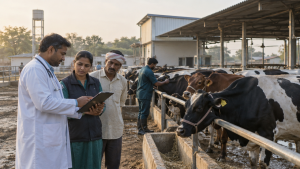
Livestock governance in India combines state-level responsibility with Union support for planning, research and development programmes. Its framework covers animal health, breeding, welfare and productivity, while linking scientific improvement of livestock to rural livelihoods and the dairy sector.
Constitutional Framework
Animal husbandry and the preservation, protection and improvement of stock fall primarily under Entry 15 of the State List in the Seventh Schedule. State governments therefore hold the principal legislative and executive responsibility for these matters, including prevention of animal diseases. Some related subjects are in the Concurrent List. Entry 17 covers prevention of cruelty to animals, while Entry 20 covers economic and social planning, allowing both Parliament and state legislatures to act within their respective powers. Article 48 of the Directive Principles of State Policy calls on the State to organise agriculture and animal husbandry on modern and scientific lines. It also directs the State to preserve and improve cattle breeds and to prohibit the slaughter of cows, calves and other milch and draught cattle. Together, these provisions make livestock governance a field in which state authority operates alongside relevant Union laws, policies and programmes.
Institutions and Division of Responsibilities
The Department of Animal Husbandry and Dairying (DAHD), under the Ministry of Fisheries, Animal Husbandry and Dairying, is the Union’s nodal agency for policy formulation, planning and implementation of livestock development programmes. Its role provides a central framework for schemes and national priorities, while state departments carry out much of the ground-level work. The Indian Council of Agricultural Research (ICAR), through its animal science research institutes, contributes research on genetic improvement, animal health management, and feed and fodder development. The National Dairy Development Board (NDDB) supports dairy-sector development, including breeding and cooperative structures. State Animal Husbandry Departments are responsible for local implementation and enforcement of regulations. This division makes coordination important: national programmes and research need to work with state-level delivery and oversight. Regulatory capacity is also relevant where states must supervise services, check compliance and support veterinary and breeding systems across varied local conditions.
Major Schemes and Initiatives
Central sector and centrally sponsored programmes address livestock productivity, breeding, disease control and infrastructure.
- National Livestock Mission (NLM): Launched in 2014–15, it seeks sustainable development of the livestock sector, with emphasis on feed and fodder development, skill development, technology transfer and entrepreneurship.
- Rashtriya Gokul Mission (RGM): Implemented under the National Programme for Bovine Breeding and Dairy Development (NPBBDD), it focuses on conserving and developing indigenous bovine breeds and raising milk production and productivity.
- National Animal Disease Control Programme (NADCP): It aims to control Foot and Mouth Disease (FMD) and Brucellosis through mass vaccination and disease surveillance. Its stated targets were control by 2025 and eradication by 2030.
- Animal Husbandry Infrastructure Development Fund (AHIDF): It supports private investment in dairy processing, meat processing and animal feed plants.
These initiatives address different parts of the livestock system: genetic resources and productivity, disease management, skills and technology, and facilities for processing and feed. Their outcomes depend on effective implementation and coordination between the Union and states.
Breeding, Animal Health and Welfare
Breeding regulation is intended to support genetic improvement while safeguarding the quality of services and breeding inputs. Minimum Standards of Practice for Artificial Insemination (AI) set expectations for the quality and efficacy of breeding services. AI and Embryo Transfer Technology (ETT) are used to propagate superior genetics. State Livestock Development Boards and Milk Federations may also be involved in regulating breeding practices and providing quality breeding inputs. Ensuring the availability and quality of semen and embryos is a continuing concern, as breeding programmes depend on reliable inputs and appropriate service delivery. The Prevention of Cruelty to Animals Act, 1960, is the primary legislation addressing animal welfare, including conditions for animals used in breeding and research. Animal identification and registration are also promoted through INAPH—the Information Network for Animal Productivity and Health—which supports traceability and disease management. Disease surveillance and control require attention to zoonotic diseases as well as livestock health. Veterinary services, diagnostics and extension activities are important to these efforts, particularly where access is difficult. The combination of health monitoring, breeding standards and welfare rules makes implementation capacity central to effective regulation.
Governance Challenges and Priorities
The scale and diversity of livestock populations place demands on veterinary infrastructure, diagnostics and extension services, including in remote areas. Strengthening disease surveillance and control, especially for zoonotic diseases, remains a priority. Consistent access to quality semen, embryos and other breeding inputs is also essential to achieving genetic improvement objectives. Indigenous breed conservation must be balanced with breeding practices that may involve cross-breeding. Effective standards can help address this concern, but implementation requires oversight and reliable information. Differences in state-level systems also make standardisation and enforcement complex. Three governance issues are particularly relevant: regulatory capacity to register and supervise providers; quality assurance for breeding material and services; and Centre–state coordination in translating national programmes and standards into local delivery. These issues connect livestock productivity with animal health, welfare and the protection of farmers’ interests.
Key Prelims Takeaways
- Constitution: Livestock and animal husbandry are primarily under State List Entry 15; cruelty prevention is under Concurrent List Entry 17.
- Article 48: Directs scientific organisation of agriculture and animal husbandry and preservation and improvement of cattle breeds.
- Institutions: DAHD is the Union nodal agency; ICAR contributes animal science research, while state departments implement and enforce regulations.
- Breeding and dairy: NLM supports sustainable livestock development; RGM focuses on indigenous bovine breeds and productivity.
- Health and infrastructure: NADCP targets FMD and Brucellosis; AHIDF supports processing and animal feed infrastructure.
- Welfare and traceability: The Prevention of Cruelty to Animals Act, 1960, addresses animal welfare; INAPH supports productivity and health information.
Recent Context
On November 9, 2026, the Odisha Cabinet approved the draft Odisha Bovine Breeding (Regulation) Bill, 2026. As of November 11, it remained proposed legislation, slated for introduction in the State Assembly’s winter session beginning November 18.
| Related | |
|---|---|