Adaptations of Desert Animals in India
Desert animals in India survive through a combination of physiological, behavioural and structural adaptations. These help them cope with heat or cold, limited water and sparse food in the Thar and the high-altitude deserts of Ladakh and Spiti.
Indian Deserts and Their Conditions
India has both hot and cold desert regions, each presenting distinct survival challenges. The Thar, or Great Indian Desert, extends across Rajasthan, Gujarat, Punjab and Haryana. It has low and erratic rainfall, averaging less than 250 mm annually, high evaporation and marked daily and seasonal temperature fluctuations. The cold deserts of Ladakh and Spiti are high-altitude arid zones. Precipitation is very low and may fall as snow, while winters are extremely cold. Adaptations suited to the hot Thar are therefore not identical to those needed in these Himalayan regions. For General Studies, these environments link climate resilience with habitat conservation and desert ecosystem management. Understanding how animals use available shelter, water and food helps explain why their habitats and ecological conditions matter.
Physiological Adaptations
Physiological adaptations are internal processes that help animals maintain essential body functions under environmental stress.
- Water conservation: Many desert animals have efficient kidneys that produce concentrated urine, reducing water loss. Some desert rodents also obtain metabolic water from dry food.
- Heat tolerance: Certain reptiles and insects can tolerate high body temperatures for limited periods. This allows them to endure heat that would be damaging to less tolerant animals.
- Salt excretion: Some desert birds and reptiles have salt glands, usually near the eyes or nostrils. These glands remove excess salt taken in with food or water and help maintain osmotic balance.
- Reduced evaporative cooling: Sweating and panting can cause substantial water loss. Many desert animals limit these processes and rely instead on behaviour, such as moving to shade or becoming active at cooler times.
Camels store fat in their humps. When metabolised, this fat provides energy and yields water; its concentration in the hump also leaves other body areas less insulated, assisting heat radiation. The hump is therefore a fat store, not a water reservoir.
Behavioural Adaptations
Behavioural strategies allow animals to avoid the most severe conditions without relying solely on internal physiological changes.
- Nocturnality: Many mammals, reptiles and invertebrates are active at night, when temperatures are lower than during the day.
- Burrowing: Rodents, reptiles and scorpions may dig burrows or occupy existing ones. These provide more stable temperatures and higher humidity than the exposed surface.
- Crepuscular activity: Some species are most active around dawn and dusk, avoiding the hottest part of the day.
- Estivation: During extreme heat and drought, some animals enter a dormant state. Their metabolic activity slows, helping them endure unfavourable conditions.
Seeking shade beneath rocks, plants or dunes is another way to avoid direct solar radiation. Together, these behaviours illustrate how animals can reduce exposure to heat and conserve water without leaving their habitat.
Structural Adaptations
Physical features can help desert animals move, regulate heat, avoid water loss or escape detection.
- Body form: Smaller body size can help dissipate heat quickly, while long limbs in some larger animals raise the body above the hot ground.
- Protective coverings: Thick skin, scales or dense fur can provide insulation and reduce water loss. Light-coloured coverings reflect more solar radiation.
- Specialised features: Camels have broad, leathery foot pads that help prevent them from sinking into sand. Long eyelashes and closable nostrils help keep sand out. Desert foxes have large, well-supplied ears that assist heat dissipation.
- Camouflage and traction: Sandy or otherwise cryptic colouring helps animals blend into their surroundings. The Indian Buthacus scorpion has stiff, elongated leg bristles called sand combs, which aid movement across loose sand.
Desert Species of India
The examples below show how different groups use distinct adaptations in India’s arid regions.
- Chinkara: Also called the Indian Gazelle, it can go for extended periods without drinking by obtaining moisture from vegetation.
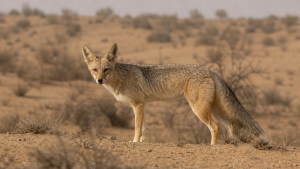
- Desert fox and desert cat: The desert fox’s large ears help dissipate heat, while its thick fur provides covering. The Indian Desert Cat has sand-coloured fur and hairy paws that aid movement on sand.
- Indian Wild Ass: Also known as the Ghudkhur, it is endemic to the Rann of Kutch.
- Birds: The Great Indian Bustard, a Critically Endangered species, is associated with the Thar’s arid grasslands. Indian Sandgrouse plumage provides camouflage.
- Reptiles: The herbivorous spiny-tailed lizard, or Uromastyx, makes deep burrows. The carnivorous Desert Monitor Lizard also burrows; sand boas and saw-scaled vipers are well camouflaged.
- Invertebrates: Indian Buthacus scorpions are nocturnal burrowers. Their pincers help them dig, while sand combs aid movement on dunes. Beetles and other insects may have tough exoskeletons.
Key Prelims Takeaways
- The Thar has low, erratic rainfall, high evaporation and extreme temperature fluctuations.
- Ladakh and Spiti are high-altitude cold deserts with very low precipitation and severe winters.
- Nocturnality, burrowing and estivation help animals avoid heat and drought.
- Concentrated urine and metabolic water are among the ways desert animals conserve water.
- Camels store fat in their humps; their broad foot pads help them walk on sand.
- The Chinkara obtains moisture from vegetation; the Indian Wild Ass is endemic to the Rann of Kutch.
- The Great Indian Bustard is Critically Endangered, and Indian Buthacus scorpions use pincers for digging and sand combs for traction.
Recent Context
Sitaram Raul won the ‘Behaviour: Invertebrates’ category at the 2026 Wildlife Photographer of the Year competition with Shifting Sand, showing an Indian Buthacus scorpion burrowing in Rajasthan’s Thar Desert. Organised by London’s Natural History Museum, the competition received over 65,000 entries; its winning-photos exhibition opened on October 16, 2026.
| Related | |
|---|---|