Major Protected Areas in Ladakh
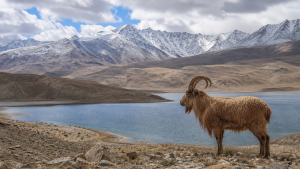
Ladakh’s protected areas conserve the cold-desert and trans-Himalayan ecosystems of the Union Territory. Their high-altitude landscapes, wetlands and pastures support distinctive wildlife, including the snow leopard, while conservation depends on managing human–wildlife interactions and involving local communities.
Hemis National Park
Hemis National Park, established in 1981 in eastern Ladakh, is India’s largest national park by area and the largest protected area within the Himalayan biome. Its elevation ranges from about 3,000 metres to over 6,000 metres. The Indus River flows along its northern boundary, and the park forms part of the Karakoram-West Tibetan Plateau Steppe ecoregion.
- Landscape: High-altitude arid grasslands, rocky outcrops and sparse alpine forests characterise the park.
- Snow leopard: Hemis is a globally renowned habitat for the snow leopard (Panthera uncia), an elusive predator of the region’s steep, rugged terrain.
- Other mammals: Species recorded include Asiatic ibex, argali (Great Tibetan sheep), bharal (blue sheep), Tibetan wolf and Eurasian brown bear.
- Birdlife and heritage: More than 160 bird species have been recorded, including the Himalayan griffon and golden eagle. Ancient monasteries also connect the park’s natural and cultural heritage.
Changthang Wildlife Sanctuary
Changthang Wildlife Sanctuary protects high-altitude wildlife and wetlands on the Changthang Plateau. Its landscape includes extensive Tibetan plateaus, cold-desert steppes and alpine pastures. Wetlands in the sanctuary are important for migratory birds and form part of a fragile trans-Himalayan ecosystem.
- Wetlands: The sanctuary includes parts of Tso Moriri, a Ramsar site, and the Tso Kar basin, an important wetland complex.
- Birds: These wetlands provide breeding grounds for migratory birds, including the endangered Black-necked Crane (Grus nigricollis).
- Mammals: The area supports the Tibetan wild ass (kiang), Tibetan gazelle, argali, bharal and the rare Pallas’s cat.
- Predators and communities: Snow leopards and Tibetan wolves are also present. Community-based conservation is relevant in a landscape used by nomadic pastoral communities.
Karakoram Wildlife Sanctuary
Located in northern Ladakh, the Karakoram Wildlife Sanctuary protects part of the eastern Karakoram Range. Its rugged mountains, glaciers and extreme elevations form a cold-desert environment extending towards the Siachen Glacier. The sanctuary’s remoteness limits human disturbance in parts of this challenging terrain.
- Chiru: The sanctuary is identified as habitat for the Tibetan antelope (Pantholops hodgsonii), also called chiru. Its fine wool is known as Shahtoosh; hunting the chiru is banned.
- Other wildlife: Snow leopard, Ladakh urial and Himalayan ibex are among the other key mammals, alongside high-altitude birds.
- Conservation value: Protecting this area helps conserve high-altitude fauna in a cold-desert setting shaped by mountains and glaciers.
Protected-Area Management and Conservation
Ladakh’s protected areas are managed under the Wildlife (Protection) Act, 1972. The Union Territory administration, through its Department of Forest, Ecology and Environment, oversees these areas. Management must address the needs of high-altitude biodiversity alongside the livelihoods and land use of local communities.
- Ecosystem functions: The protected-area network contributes to the ecological integrity of the Western Himalayas and the Trans-Himalayan biogeographic zone. It also supports hydrological cycles, glacier preservation and carbon sequestration.
- Management issues: High-altitude conditions make conservation challenging. Management priorities include protecting habitats, addressing human–wildlife conflict, and maintaining conservation funding.
- Community role: Engagement with pastoral communities is important to conservation, particularly where wildlife shares landscapes with livestock and local livelihoods.
Snow Leopard Conservation in Ladakh
The snow leopard is an apex predator and an indicator of healthy high-altitude ecosystems. Its Indian range includes the trans-Himalayan regions of Ladakh, Himachal Pradesh, Uttarakhand, Sikkim and Arunachal Pradesh. Rocky slopes and steep terrain provide the cover and habitat it favours.
- Population: Ladakh is estimated to have 477 snow leopards, out of an estimated Indian total of 718.
- Conservation approach: Priorities include habitat protection, reducing human–wildlife conflict and involving local communities.
- Programmes: The Government of India’s Project Snow Leopard promotes a participatory approach. The Global Snow Leopard and Ecosystem Protection Program (GSLEP) supports regional initiatives.
- SHAN Society: The Snow Leopard and High-Altitude Nature Conservation (SHAN) Society was approved for constitution in June 2026. It provides an institutional mechanism for wildlife conservation and community-led environmental stewardship.
Key Prelims Takeaways
- Hemis National Park: Established in 1981; India’s largest national park by area and a key snow leopard habitat.
- Changthang: Includes parts of Tso Moriri, a Ramsar site, and the Tso Kar wetland basin.
- Karakoram: Protects high-altitude fauna, including the Tibetan antelope or chiru, associated with Shahtoosh wool.
- Snow leopard: Scientific name Panthera uncia; Ladakh has an estimated 477 of India’s 718.
- Legal framework: Protected areas are governed under the Wildlife (Protection) Act, 1972.
- Wildlife Week: Observed annually in India from 2 to 8 October.
Recent Context
On 7 October 2026, during Wildlife Week, Ladakh launched India’s first high-altitude snow leopard wildlife safari. Lieutenant Governor Vinai Kumar Saxena flagged off six open-back vehicles for the initiative, a collaboration between SHAN Society and the UT Department of Forest, Ecology and Environment. Initial routes are planned for Rumbak, Shang and Uley; future routes may include Hemis, Changthang, Karakoram, Nubra, Zanskar, Sham, Kargil and Drass. The initiative aims to promote responsible tourism, community-based conservation and sustainable livelihoods.
| Related | |
|---|---|