Major Indian Naval Warships and Frigates
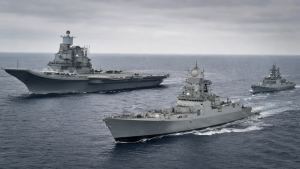
The Indian Navy’s surface and undersea fleet is built around aircraft carriers, destroyers, frigates and submarines. Together, these warships support sea control, deterrence, maritime surveillance and power projection across the Indian Ocean Region, while also reflecting India’s growing focus on indigenous shipbuilding and modern combat systems.
Aircraft Carriers
- INS Vikramaditya: The flagship of the Indian Navy, INS Vikramaditya is a modified Kiev-class aircraft carrier acquired from Russia. Commissioned in 2013, it has a displacement of about 45,400 tonnes and operates MiG-29K fighter jets.
- STOBAR system: Both Indian aircraft carriers use the Short Take-Off Barrier Arrested Recovery system, which supports ski-jump take-off and arrested recovery of aircraft.
- INS Vikrant (IAC-1): Commissioned in 2022, INS Vikrant is India’s first indigenous aircraft carrier and the largest warship built in the country.
- Indigenous content: Built by Cochin Shipyard Limited, INS Vikrant has a displacement of around 45,000 tonnes and a high degree of indigenisation, with about 76% indigenous content.
- Air wing: The carrier operates MiG-29K aircraft, Kamov-31 airborne early warning helicopters and MH-60R multi-role helicopters.
Destroyers: Kolkata and Visakhapatnam Classes
- Kolkata-class (Project 15A): These guided-missile stealth destroyers include INS Kolkata, INS Kochi and INS Chennai. Built by Mazagon Dock Shipbuilders Limited (MDL), they displace about 7,400 tonnes.
- Weapons and sensors: The class is equipped with BrahMos supersonic cruise missiles, Barak 8 long-range surface-to-air missiles, and advanced sensors and electronic warfare systems.
- Role: Kolkata-class destroyers are designed for anti-air, anti-surface and anti-submarine warfare, making them among the Navy’s most capable surface combatants.
- Visakhapatnam-class (Project 15B): An advanced derivative of the Kolkata class, this series includes INS Visakhapatnam, INS Mormugao, INS Imphal and INS Surat.
- Capabilities: Built by MDL, these destroyers also displace around 7,400 tonnes and feature stealth improvements, BrahMos and Barak 8 missiles, indigenous torpedo tube launchers and anti-submarine rocket launchers.
Frigates: Shivalik, Talwar and Nilgiri Classes
- Shivalik-class (Project 17): India’s first stealth frigates, the class comprises INS Shivalik, INS Satpura and INS Sahyadri. They were built by MDL and Garden Reach Shipbuilders & Engineers (GRSE).
- Displacement and armament: Shivalik-class frigates displace about 6,200 tonnes and carry Club-N anti-ship missiles, BrahMos, Barak 1 short-range surface-to-air missiles and anti-submarine rockets.
- Talwar-class: These are guided-missile frigates acquired from Russia for operations in open ocean and littoral waters. Examples include INS Talwar, INS Trishul, INS Tabar and INS Teg.
- Systems: Talwar-class frigates displace around 4,000 tonnes and are equipped with BrahMos or Club anti-ship missiles, Shtil-1 air-defence systems and RBU-6000 anti-submarine rocket launchers.
- Nilgiri-class (Project 17A): This is the follow-on stealth frigate class to the Shivalik class. Seven ships are planned under the project, with construction at MDL and GRSE.
- Advanced design: Nilgiri-class frigates will displace about 6,670 tonnes and feature a Distributed Combat Management System and BrahMos missiles.
Submarines: Kalvari and Arihant Classes
- Kalvari-class (Project 75): These are conventional diesel-electric attack submarines based on the Scorpene design and built by MDL.
- Fleet composition: Six submarines are planned under the class, including INS Kalvari, INS Khanderi, INS Karanj, INS Vela and INS Vagir.
- Operational roles: Kalvari-class submarines are designed for anti-surface warfare, anti-submarine warfare, intelligence gathering, mine laying and area surveillance.
- Armament: They are equipped with torpedoes and tube-launched anti-ship missiles.
- Arihant-class: This is India’s indigenous nuclear-powered ballistic missile submarine (SSBN) class and a key pillar of nuclear deterrence.
- INS Arihant: The first submarine in the class was commissioned in 2016 and is capable of carrying ballistic missiles.
Key Prelims Takeaways
- INS Vikramaditya: Modified Kiev-class aircraft carrier, acquired from Russia, commissioned in 2013, and operates MiG-29K jets.
- INS Vikrant (IAC-1): India’s first indigenous aircraft carrier, built by Cochin Shipyard Limited and commissioned in 2022.
- Kolkata-class: Project 15A guided-missile stealth destroyers built by MDL; includes INS Kolkata, Kochi and Chennai.
- Visakhapatnam-class: Project 15B destroyers with stealth improvements, BrahMos and Barak 8 missiles, built by MDL.
- Shivalik-class: India’s first stealth frigates under Project 17, built by MDL and GRSE.
- Nilgiri-class: Project 17A follow-on stealth frigates with advanced combat systems and BrahMos capability.
- Kalvari-class and Arihant-class: The former are conventional attack submarines; the latter are indigenous SSBNs central to nuclear deterrence.
BrahMos is a long-range, ramjet-powered supersonic cruise missile system and a joint venture between India and Russia. It is used by the Army, Navy and Air Force.
ACTAS stands for Active Towed Array Sonar, an advanced underwater detection system. UVLM means Universal Vertical Launch Module, which can launch BrahMos missiles.
Recent Context
INS Trishul (F43), a Talwar-class guided missile frigate, arrived at the Toulon naval base in France on September 22, 2026, for the 24th edition of Exercise Varuna. The India-France naval exercise began in 1983 and was named “Varuna” in 2001. It includes harbour and sea phases and supports interoperability in anti-submarine warfare, replenishment-at-sea and cross-deck operations.
| Related | |
|---|---|