Types of Electrolysers and Hydrogen Production Methods
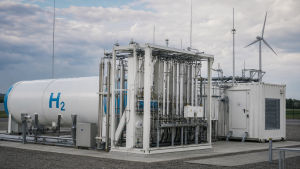
Hydrogen is emerging as an important clean energy carrier for hard-to-abate sectors such as refining, fertilisers, steel and transport. Since it does not occur freely in nature in usable form, it must be produced through different pathways, each with distinct emissions, costs and applications. Electrolysis is central to green hydrogen, and the equipment used for it is called an electrolyser.
Hydrogen Production Methods and the Colour Code
Hydrogen is often classified by the way it is produced, especially on the basis of carbon emissions. This colour code is widely used in current affairs and exam questions.
- Grey Hydrogen: Produced from natural gas through steam methane reforming. It releases carbon dioxide directly into the atmosphere and remains the most common and cost-effective method.
- Blue Hydrogen: Also produced from natural gas through steam methane reforming, but the carbon dioxide is captured and stored using Carbon Capture and Storage (CCS).
- Green Hydrogen: Produced by electrolysis of water using renewable electricity such as solar or wind power. It is considered the cleanest option because production does not emit greenhouse gases.
- Pink Hydrogen: Produced through electrolysis powered by nuclear energy.
- Yellow Hydrogen: Produced through electrolysis using electricity from a mixed grid containing both renewable and fossil fuel sources.
- Black/Brown Hydrogen: Produced from coal gasification, with high carbon emissions. Black hydrogen generally refers to bituminous coal and brown hydrogen to lignite.
- Turquoise Hydrogen: Produced by methane pyrolysis, where natural gas is decomposed into hydrogen and solid carbon at high temperatures.
- White Hydrogen: Refers to naturally occurring geological hydrogen.
Electrolysis and Electrolysers
Electrolysis is an electrochemical process in which electricity is used to split water (H2O) into hydrogen (H2) and oxygen (O2). The process takes place in an electrolyser, which generally has an anode, a cathode and an electrolyte or membrane that allows ion transfer.
The type of electrolyte, operating temperature and ion-conducting mechanism determine the category of electrolyser. In practice, electrolysers are chosen based on efficiency, flexibility, cost and compatibility with renewable power sources.
Types of Electrolysers
- Alkaline Electrolysers (AEL): These use a liquid alkaline electrolyte, usually potassium hydroxide (KOH) or sodium hydroxide (NaOH).
- Operation: They generally work at moderate temperatures of about 60°C to 90°C. Water molecules split at the cathode, producing hydrogen gas and hydroxide ions. The hydroxide ions move through the electrolyte to the anode, where oxygen gas is formed.
- Characteristics: Alkaline electrolysers are the most mature and commercially available technology. They are durable, reliable and relatively low in capital cost, making them suitable for large-scale continuous hydrogen production.
- Limitation: They respond slowly to changes in power supply, so they are less suitable for direct coupling with variable renewable energy.
- Efficiency: Electrical efficiency is typically in the range of 65% to 75% on a lower heating value basis.
- Proton Exchange Membrane (PEM) Electrolysers: These use a solid polymer membrane that conducts protons.
- Operation: Water reacts at the anode to form oxygen and positively charged hydrogen ions. The protons move across the membrane to the cathode, where they combine with electrons to form hydrogen gas.
- Characteristics: PEM electrolysers offer high current density, rapid response and compact design. They are well suited for integration with intermittent renewable sources such as solar and wind and can produce high-purity hydrogen.
- Limitation: Their capital cost is higher, partly because they use noble metal catalysts.
- Efficiency: Electrical efficiency is generally around 65% to 75%, and in some systems it can reach 75% to 82%.
- Solid Oxide Electrolysis Cells (SOEC): These use a solid ceramic electrolyte that conducts oxygen ions.
- Operation: SOECs operate at very high temperatures, usually between 600°C and 1000°C. Steam at the cathode forms hydrogen and oxygen ions, which pass through the ceramic membrane to the anode and form oxygen gas.
- Characteristics: High operating temperatures reduce electricity demand because heat also contributes to the process. This makes SOECs attractive for industrial facilities with available waste heat. They can also co-electrolyse carbon dioxide to produce syngas.
- Limitation: They face material stress at high temperatures and have slow start-up and shutdown times.
- Efficiency: They can achieve electrical efficiencies of up to 90%, and even around 100% when excess heat is used.
Why Electrolyser Type Matters
For India’s green hydrogen push, electrolyser selection is not only a technology issue but also a cost and scale issue. Alkaline electrolysers remain important for stable, large-volume production, while PEM systems are better suited to fluctuating renewable electricity. SOEC technology offers high theoretical efficiency but needs stronger R&D, better materials and industrial heat integration.
These differences matter because the economics of green hydrogen depend on electricity cost, plant utilisation, stack durability and the ability to manufacture electrolysers at scale. As a result, policy support and domestic manufacturing capacity are crucial for competitiveness.
National Green Hydrogen Mission
The Government of India approved the National Green Hydrogen Mission on January 4, 2023. The mission aims to make India a global hub for the production, use and export of green hydrogen and its derivatives.
- Initial outlay: Rs. 19,744 crore.
- Production target by 2030: At least 5 million metric tonnes per annum of green hydrogen.
- Renewable energy addition: About 125 GW.
- Investment expected: Over Rs. 8 lakh crore.
- Employment potential: More than 6 lakh jobs.
- Emission reduction: Nearly 50 million metric tonnes of greenhouse gas emissions annually.
- Import savings: Over Rs. 1 lakh crore in cumulative fossil fuel import reduction.
The mission includes the Strategic Interventions for Green Hydrogen Transition (SIGHT) programme, which provides incentives for electrolyser manufacturing and green hydrogen production. This is important for building domestic capability, lowering costs and reducing dependence on imported technology.
Hydrogen Storage and Applications
Hydrogen has low volumetric energy density, so storage is an important part of the hydrogen value chain. Its storage mode depends on the end use, cost and infrastructure available.
- Compressed gas: Stored in high-pressure tanks, usually at 350 to 700 bar.
- Liquid hydrogen: Requires liquefaction at -253°C.
- Solid-state storage: Uses materials such as metal hydrides to store hydrogen.
- Chemical carriers: Includes ammonia and liquid organic hydrogen carriers (LOHCs).
Hydrogen is used in industrial process fuel, oil refining, ammonia and methanol production, power generation and transport, including fuel cell vehicles. It can also be blended with natural gas in existing systems.
Key Prelims Takeaways
- Green hydrogen: Produced by electrolysis using renewable electricity.
- Electrolyser: Equipment that splits water into hydrogen and oxygen.
- Main types: Alkaline, PEM and Solid Oxide electrolysers.
- Alkaline systems: Mature, cost-effective and suitable for large-scale continuous production.
- PEM systems: Fast response, compact and suitable for variable renewable power.
- SOEC systems: High-temperature units with strong efficiency potential and waste-heat compatibility.
- National Green Hydrogen Mission: Approved on January 4, 2023, with an outlay of Rs. 19,744 crore and a target of 5 MMT green hydrogen by 2030.
- Mission targets: About 125 GW renewable capacity, over Rs. 8 lakh crore investment and more than 6 lakh jobs by 2030.
- Storage options: Compressed gas, liquid hydrogen, solid-state storage and chemical carriers.
Recent Context
Maruti Suzuki India Limited commissioned its first green hydrogen electrolyser plant at Manesar, Haryana, on September 24, 2026. The 300 kW pilot unit uses surplus solar power for hydrogen production, which is blended with natural gas for process fuel in manufacturing operations.
| Related | |
|---|---|