Major Artificial Intelligence Hubs and Ecosystems in India
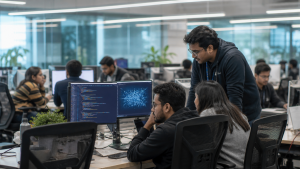
India’s artificial intelligence landscape is expanding quickly, supported by a mix of startups, research institutions, large technology firms, and growing digital infrastructure. The country’s AI growth is concentrated in a few major cities, but it also depends on national policies, talent pipelines, and compute-heavy data centre ecosystems.
What Makes an AI Ecosystem
An AI ecosystem is more than a set of software companies. It is a connected network that enables research, model development, deployment, and scale. For Prelims, the important point is that AI growth depends on both human capability and physical infrastructure.
- Talent pool: Skilled AI professionals, researchers, data scientists, and engineers.
- Research and development: Universities, government labs, and corporate R&D centres that create new methods and applications.
- Startups and innovation: New firms that build AI products for healthcare, finance, agriculture, retail, and manufacturing.
- Funding and investment: Venture capital, government support, and private sector spending.
- Infrastructure: Data centres, cloud services, high-speed connectivity, and power supply.
- Data availability: Large and high-quality datasets needed for training and testing models.
- Policy and regulation: Government rules, ethical guidelines, and responsible AI frameworks.
Major AI Hubs in India
India’s AI activity is not evenly spread. A few cities have become preferred locations because they combine talent, institutions, startups, enterprise demand, and digital infrastructure.
- Bengaluru: Often called India’s Silicon Valley, it leads in AI startup activity, multinational R&D centres, incubators, and access to tech talent.
- Hyderabad: Emerging as a major data centre and AI compute hub, supported by connectivity, power availability, and a strong technology ecosystem.
- Delhi-NCR: Includes Delhi, Gurugram, and Noida, with a dense presence of IT companies, startups, and academic institutions.
- Mumbai: A financial capital where AI adoption is strong in fintech, enterprise services, and digital commerce.
- Chennai: Known for manufacturing and IT services, with growing use of AI in industrial automation and software development.
- Pune: A growing IT and automotive centre where AI applications are expanding with support from industry and academia.
Government Initiatives and AI Policy
AI policy in India is shaped by a combination of strategic vision, digital public infrastructure, and skills programmes. The focus is not only on innovation, but also on inclusive and responsible use of AI.
- National Strategy for Artificial Intelligence: NITI Aayog released the discussion paper #AIforAll in June 2018. It emphasised inclusive growth and the use of AI for societal needs.
- Responsible AI for Youth: A programme aimed at building foundational AI knowledge among students, especially from economically weaker sections.
- National AI Portal: indiaai.gov.in is a central knowledge hub jointly supported by MeitY, NeGD, and NASSCOM.
- Digital India Programme: Provides the digital backbone needed for AI development and deployment.
- MeitY initiatives: The Ministry of Electronics and Information Technology supports AI startups, research, and ecosystem building.
- National Programme on AI: Announced in the Union Budget 2023, with emphasis on making AI in India and making AI work for India.
- AI governance: The policy debate also includes ethical use, accountability, and regulatory readiness, which are increasingly important as AI expands.
Data Centres, GPUs and AI Infrastructure
AI systems require enormous computing power. That is why data centres have become central to India’s AI ecosystem, especially for large-scale model training, inference, and cloud-based services.
- Hyperscale data centres: Large facilities built for cloud computing, storage, and high-volume digital services.
- GPUs: Graphics Processing Units are widely used in AI and machine learning because they handle parallel processing efficiently.
- IT load: Data centre capacity is often measured in megawatts (MW) or gigawatts (GW) of IT load.
- Cloud infrastructure: Scalable cloud systems are essential for AI training, deployment, and inference.
- Advanced cooling: New AI projects increasingly require high-density design and advanced cooling systems.
- Data exchange platforms: Planned systems such as the Telangana Data Exchange are intended to offer sovereign AI-grade computing, AI-ready datasets, subsidised GPU access, and sandbox tools.
Academic and Research Contribution
India’s AI ecosystem is supported by a strong base of technical institutions and research networks. These institutions supply the skilled workforce and the research output needed for long-term growth.
- IITs and IIITs: These institutes offer specialised courses and conduct research in AI and machine learning.
- IISc, Bengaluru: A major centre for scientific and technological research, including AI-related work.
- Government and corporate labs: Research centres contribute to both foundational and applied AI development.
- Skill development: Vocational training and online platforms are helping expand the AI-ready workforce.
- Skilling needs: As AI expands, India must bridge the gap between available talent and rapidly changing industry requirements.
Telangana and Hyderabad as an Emerging AI-Compute Cluster
Telangana has become one of the most visible examples of how AI growth and digital infrastructure are converging. Hyderabad is gaining importance as a data centre hub, while the state is positioning itself around large-scale compute and AI investment.
- Capacity growth: As of September 24, 2026, Telangana has more than 2.5 GW of data centre capacity either operational or under development.
- Future target: The state aims for 5 GW of hyperscale data centre capacity by 2029, linked to an estimated USD 30 billion in potential investment in AI and digital infrastructure.
- Major operators: Microsoft, AWS, Iron Mountain, CtrlS, Sify, TCL, NTT DATA, and CapitaLand are among the companies involved in data centre projects in Telangana.
- Large projects: On September 5, 2026, Telangana announced a ₹70,000 crore investment by Tata Group, TCS, and HyperVault for an AI data centre campus in Hyderabad.
- Campus scale: The proposed Tata Group/TCS/HyperVault campus is planned for up to 1 GW capacity.
- Other planned investment: Fortune Hospitality & Infra has planned a 170-acre hyperscale AI data centre park in Telangana with an initial investment of ₹60,000 crore.
- Project design: New facilities are being designed for AI-scale compute, high-density GPUs, hyperscale cloud, and advanced cooling systems.
Key Prelims Takeaways
- #AIforAll: Title of NITI Aayog’s discussion paper on the National Strategy for Artificial Intelligence.
- National AI Portal: indiaai.gov.in, a joint initiative of MeitY, NeGD, and NASSCOM.
- CAIR: Centre for Artificial Intelligence and Robotics, a DRDO laboratory.
- Hyderabad: One of India’s major data centre hubs because of connectivity, power availability, and technology ecosystem.
- GPUs: Key hardware for AI and machine learning workloads.
- IT load: Data centre capacity is measured in MW or GW.
- Major AI hubs: Bengaluru, Hyderabad, Delhi-NCR, Mumbai, Chennai, and Pune.
Recent Context
Telangana’s AI and data centre push has intensified with new large-scale investments, including Microsoft’s India South Central data centre region and the Tata Group-TCS-HyperVault campus announcement. These projects underline the state’s goal of becoming a major global AI hub by 2035 through compute capacity, infrastructure, and ecosystem building.
| Related | |
|---|---|