Key Features of the Moon’s South Pole
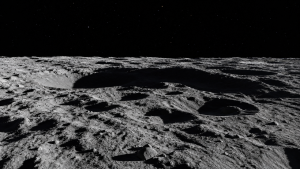
The Moon’s south pole is one of the most rugged and scientifically important regions on the lunar surface, with deep craters, permanently shadowed zones, and strong prospects for water ice.
Geographic and Terrain Overview
The Moon’s South Pole lies between 80°S and 90°S latitude. Unlike the flatter equatorial plains explored in earlier space programs, the south polar region is highly rugged, with mountainous rims and deep craters. This creates a landscape of perpetual light and darkness.
The Moon’s axial tilt is only 1.54 degrees, so the Sun stays very close to the horizon at the poles. Sunlight reaches only elevated crater rims and peaks, while deep crater floors receive no direct solar rays. These dark areas are called Permanently Shadowed Regions (PSRs).
Craters and Permanently Shadowed Regions
The south polar landscape is shaped by massive impact craters. Some of the most studied craters in this region include:
- Shackleton Crater: Located almost exactly at the south pole, this crater is 21 kilometers wide and over 4 kilometers deep. Its rim receives near-constant sunlight, while its interior remains in permanent darkness.
- Faustini Crater: Situated near the pole, this crater contains smaller doubly shadowed depressions that preserve ancient materials.
- Cabeus and de Gerlache Craters: These are deep cold traps where thermal conditions allow volatiles to remain stable for billions of years.
The South Pole-Aitken Basin, a vast impact structure about 2,500 kilometers in diameter and 6 to 8 kilometers deep, lies in this southern hemisphere. It is one of the largest known impact structures in the solar system.
Water Ice and Subsurface Volatiles
The presence of water ice at the lunar south pole makes it a major target for resource utilization. The Permanently Shadowed Regions act as cold traps, capturing volatile compounds from comets, asteroid impacts, and solar wind interactions.
- Detection History: In 2008, the Moon Mineralogy Mapper (M3) aboard Chandrayaan-1 detected water-ice molecules on the surface of polar craters. In 2009, NASA’s LCROSS mission collided with Cabeus crater and detected 155 kilograms of water vapor in the resulting debris plume.
- Subsurface Ice Mapping: In 2026, researchers analyzing data from the Chandrayaan-2 Dual Frequency Synthetic Aperture Radar (DFSAR) identified subsurface ice in a 1.1-kilometer-wide crater within Faustini crater.
- Radar Signatures: The DFSAR system works in L-band and S-band frequencies. It identified ice-bearing material using a Circular Polarization Ratio (CPR) greater than 1 and a Degree of Polarization (DoP) below 0.13, indicating volumetric scattering caused by frozen water.
Temperature Profiles and Thermal Gradients
Temperatures in the permanently shadowed craters of the South Pole are among the coldest in the solar system. These areas maintain steady temperatures of about 25 Kelvin (-248°C or -414°F), cold enough to prevent water ice from sublimating into space.
In contrast, surrounding sunlit regions experience sharp thermal variation. In-situ thermal measurements collected by Chandra’s Surface Thermo-physical Experiment (ChaSTE) during the Chandrayaan-3 mission found a steep thermal gradient just beneath the surface.
- Surface Temperature: The probe recorded temperatures of about 50°C at the immediate surface.
- Subsurface Temperature: Just 80 millimeters below the surface, the temperature dropped sharply to -10°C. This shows that lunar regolith is an excellent thermal insulator.
Lunar Ionosphere and Plasma Dynamics
The south polar environment has a thin, electrically active plasma layer just above the surface. This lunar ionosphere forms through interactions between the solar wind, ultraviolet light, and occasional exposure to Earth’s magnetotail.
The RAMBHA-LP (Radio Anemometry of Moon Bound Hypersensitive Ionosphere and Atmosphere – Langmuir Probe) instrument on Chandrayaan-3 recorded direct measurements of this plasma at Shiv Shakti Point (69.37°S latitude).
- Electron Density: 380 to 600 particles per cubic centimeter.
- Kinetic Temperature: 3,000 to 8,000 Kelvin.
- Variability: Plasma density and energy fluctuate with orbital phase, solar wind exposure, and shielding by Earth’s magnetotail.
Subsurface Geology and Primordial Magma
Geological mapping of the south polar highlands is helping scientists reconstruct the early history of the Moon.
- Lunar Magma Ocean Hypothesis: Data from the Alpha Particle X-ray Spectrometer (APXS) on the Pragyan rover confirmed primordial magma remnants beneath the polar surface. This supports the theory that the Moon was once covered by a global ocean of molten rock.
- Age of the Region: Geological analysis of impact craters near the landing site traces crust formation to about 3.7 billion years ago, a period that overlaps with the emergence of early microbial life on Earth.
- Impact Preservation: Unlike Earth, where plate tectonics and atmospheric weathering erase craters, the Moon preserves these structures as time capsules of early solar system history.
Summary of Key Lunar South Pole Exploration Missions
| Mission Name | Space Agency / Country | Launch / Landing Year | Key Target and Objectives |
| Chandrayaan-3 | ISRO (India) | 2023 | Landed at 69.37°S latitude; measured near-surface plasma and subsurface thermal gradients. |
| Chang’e-7 | CNSA (China) | 2026 | Targets Shackleton Crater; uses an orbiter, lander, rover, and a hopping probe to search for water molecules inside shadowed craters. |
| LUPEX | ISRO & JAXA (India / Japan) | Future | Joint robotic mission aimed at drilling and analyzing water ice on the lunar surface. |
| Artemis III | NASA (USA) | Future | Human landing mission targeting the south pole to establish a long-term exploration base. |
These features make the Moon’s South Pole a central focus of modern space exploration. Its thermal, chemical, and physical conditions are important for future deep-space transit and habitat construction.
Recent Context
On 23 August 2026, China postponed the Chang’e-7 lunar mission after it failed to meet launch criteria for its window. The mission remains focused on searching for water ice near the south pole, with support from a multi-component robotic payload.
Rare Facts for Prelims
- Nearly constant sunlight: Some crater rims near the south pole can receive sunlight for long periods while nearby floors remain completely dark.
- Cold traps preserve volatiles: PSRs can hold water ice and other volatile compounds for billions of years because temperatures stay extremely low.
- Shackleton’s importance: Shackleton Crater is one of the most studied lunar sites because it lies close to the pole and has both illuminated rims and shadowed interiors.
- Radar clue for ice: A Circular Polarization Ratio above 1 is a strong indicator of ice-bearing material in lunar radar studies.
- Moon as a geological archive: The Moon preserves impact records much better than Earth because it lacks active plate tectonics and thick atmosphere.
- ISRU relevance: Water ice at the lunar south pole is important not only for science but also for in-situ resource utilization, including future human bases.
| Related | |
|---|---|