Major Human Brain Cell Types and Their Roles
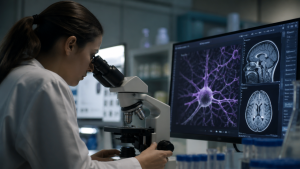
The human brain works through a highly organized mix of neurons and support cells. Neurons carry signals, while glial and other specialized cells maintain structure, immunity, insulation, and fluid balance. For Prelims revision, the key is to remember each cell type and its core function in brain communication and health.
Neurons: The Brain’s Communicators
Neurons are the basic functional units of the nervous system. They transmit electrical and chemical signals and link different brain regions as well as the brain with the rest of the body. Their structure is adapted for fast, directed communication.
- Soma: The cell body contains the nucleus and organelles and carries out metabolic functions.
- Dendrites: Branch-like extensions that receive signals from other neurons.
- Axon: A long projection that carries signals away from the cell body to other neurons, muscles, or glands.
- Synapse: The junction where one neuron communicates with another cell, usually through neurotransmitters.
- Functional types: Sensory neurons carry information from the senses, motor neurons control muscles, and interneurons connect other neurons.
Glial Cells: The Brain’s Support System
Glial cells, or neuroglia, are non-neuronal cells that support, nourish, and protect neurons. They are more numerous than neurons and are essential for maintaining the brain’s internal environment.
Astrocytes
- Shape and location: Star-shaped cells found in the central nervous system.
- Abundance: They are the most abundant glial cells.
- Blood-brain barrier: They help form and maintain this protective barrier that regulates what enters the brain from the blood.
- Metabolic support: They supply nutrients and help regulate the brain’s chemical environment.
- Neurotransmitter regulation: They can absorb and release neurotransmitters, influencing synaptic activity.
- Injury response: After brain injury, they can proliferate and form glial scars, which protect tissue but may limit regeneration.
Oligodendrocytes
- Main role: They produce myelin in the central nervous system.
- Myelin sheath: This fatty insulating layer wraps around axons.
- Signal speed: Myelin greatly increases the speed and efficiency of nerve impulse transmission.
- One-to-many function: A single oligodendrocyte can myelinate multiple axons.
- PNS comparison: In the peripheral nervous system, Schwann cells perform a similar myelinating role.
Microglia
- Immune role: They are the resident immune cells of the central nervous system.
- Surveillance: They continuously monitor the brain for pathogens, damaged cells, and other threats.
- Phagocytosis: They engulf and clear debris, dead neurons, and infectious agents.
- Inflammation and repair: They participate in inflammatory responses and tissue repair after injury.
- Disease link: Dysfunction of microglia is implicated in several neurodegenerative diseases.
Other Brain Cell Types
- Ependymal cells: They line the ventricles of the brain and the central canal of the spinal cord, and help in the production and circulation of cerebrospinal fluid (CSF).
- Endothelial cells: They form the walls of blood vessels in the brain and contribute to blood-brain barrier function.
- Pericytes: These cells wrap around capillaries and venules and help maintain blood-brain barrier integrity.
Brain Regions and Cellular Specialization
Different brain regions contain different densities and compositions of cell types, depending on function. The dorsolateral prefrontal cortex, located in the frontal lobe of the cerebrum, is especially important for executive functions such as working memory, planning, decision-making, and cognitive control. Its complex cellular organization supports higher-order cognition.
- Prefrontal cortex: A part of the frontal lobe of the cerebrum.
- Dorsolateral prefrontal cortex: A key area for executive functions and cognitive control.
- Functional link: Cellular specialization in this region supports complex thinking and behavioral regulation.
Cellular Development Across the Lifespan
Brain cells change significantly from childhood to old age. The dorsolateral prefrontal cortex develops through childhood and adolescence and reaches mature cellular organization in adulthood. Recent gene-activity studies have described distinct phases of change in this region across the human lifespan.
- Early phase: Major gene-expression changes occur before adulthood.
- Middle phase: Early and middle adulthood show relative stability.
- Later phase: Older age shows renewed changes, especially in glial support cells and immune cells.
- Completion: Maturation of the prefrontal cortex is largely complete around age 24.
Key Prelims Takeaways
- Neurons are the main signal-transmitting cells of the nervous system.
- Dendrites receive signals, while axons carry them away from the cell body.
- Glial cells support, nourish, and protect neurons.
- Astrocytes help form the blood-brain barrier and regulate the brain’s chemical environment.
- Oligodendrocytes produce myelin in the CNS and speed up signal transmission.
- Microglia are the brain’s resident immune cells and clear debris through phagocytosis.
- Ependymal cells line brain ventricles and are involved in CSF production and circulation.
Recent Context
A human brain-cell atlas published in Nature on September 23, 2026 mapped gene activity in the dorsolateral prefrontal cortex across the lifespan. It analyzed nuclei from over 6.3 million brain cells from 1,494 deceased donors, including people with and without major brain disorders, and identified three transcriptomic acts in this region.
| Related | |
|---|---|