Important Asian Games Facts and Records
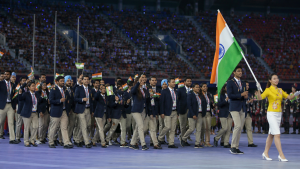
The Asian Games, or Asiad, is Asia’s premier multi-sport event and the second-largest multi-sport competition in the world after the Olympics. Held every four years, it combines sporting excellence with regional cooperation, national prestige and long-standing sports administration under the Olympic Council of Asia.
Origin, Formation and Early History
The Asian Games emerged after World War II as Asian leaders sought a platform to promote unity and cooperation through sport. Indian representative Guru Dutt Sondhi played a key role in proposing the idea at the 1948 London Olympics.
- Asian Games Federation (AGF): Formally established on 13 February 1949 in New Delhi.
- First Asian Games: Held in New Delhi from 4 to 11 March 1951; originally scheduled for 1950 but postponed due to preparation delays.
- Motto: Ever Onward, proposed by Guru Dutt Sondhi.
- Frequency: The Games are held quadrennially, every four years.
- Recognition: The event is recognised by the International Olympic Committee (IOC).
Symbol, Emblem and Identity
The Asian Games symbol and motto reflect the spirit of Asia and its sporting unity. The emblem has remained an important visual identity for the event across editions.
- Emblem: A bright red sun with 16 rays and a white circle in the centre.
- Meaning: The design is meant to represent the warm, ever-glimmering spirit of the Asian people.
- First Games paraphernalia: The Maharaja of Patiala presented the torch and flag for the inaugural Asian Games.
- Legacy: The Games were designed not only as a sporting competition but also as a symbol of Asian solidarity and identity.
Governing Body: Olympic Council of Asia
The Olympic Council of Asia (OCA) is the governing body for sport in Asia and has organised the Asian Games since 1982. It replaced the Asian Games Federation after the latter was disbanded on 16 November 1982.
- Headquarters: Kuwait City, Kuwait.
- Membership: Represents 45 National Olympic Committees (NOCs) across Asia.
- Eligibility: All 45 affiliated members are eligible to participate in the Games.
- IOC recognition: The OCA is recognised by the IOC.
- Administrative role: It oversees the conduct, organisation and continuity of the Games in Asia.
Medal Table and Major Performing Nations
Over the years, 46 nations have participated in the Asian Games. The medal standings are led by the traditional sporting powers of Asia, with China, Japan and South Korea consistently finishing at the top.
- All-time leader: China tops the overall medal table.
- Other leading nations: Japan and South Korea follow China in the all-time standings.
- India’s position: India is the fifth-most successful country at the Asian Games by total medals.
- Best overall finish: India finished second at the first Asian Games in 1951.
- Best medal haul: 107 medals at the 2022 Hangzhou Asian Games (held in 2023), including 28 gold, 38 silver and 41 bronze.
- Best rank in modern era: India finished fourth in Hangzhou.
- Hosting record: India has hosted the Asian Games twice — New Delhi 1951 and 1982.
India’s Key Asian Games Records
India has participated in every edition of the Asian Games and has won at least one gold medal in each edition. Athletics has been India’s most productive discipline, while several individual athletes have created landmark records.
- First gold medallist: Swimmer Sachin Nag won the 100m freestyle at New Delhi 1951.
- First Indian woman medallist: Roshan Mistry won silver in the 100m sprint in 1951.
- Most decorated Indian athlete: PT Usha has won 11 medals — 4 gold and 7 silver — across four editions from 1982 to 1994.
- PT Usha’s standout edition: At the 1986 Seoul Games, she won four golds in the 200m, 400m, 400m hurdles and 4x400m relay, plus silver in the 100m.
- Athletics contribution: Nearly 37% of India’s Asian Games medals have come from athletics.
- Athletics tally: India has won 283 athletics medals — 85 gold, 102 silver and 96 bronze.
- Kabaddi dominance: India has won eight out of nine Asian Games kabaddi titles since the sport’s debut in 1990.
- Cricket debut success: India’s men’s and women’s cricket teams won gold at the Hangzhou 2022 Games, held in 2023.
Squash at the Asian Games and Olympic Link
Squash has been part of the Asian Games since 1998, when it was introduced at the Bangkok edition. The sport has gained added importance because it will make its Olympic debut at the 2028 Los Angeles Olympics.
- Events: Men’s singles, women’s singles, men’s doubles, women’s doubles and mixed doubles.
- Mixed doubles: Added for the first time at the 2022 Hangzhou Asian Games.
- Olympic debut: Squash will feature at the 2028 Los Angeles Olympics.
- Qualification route: The Asian Games 2026 will begin qualification for LA28 in squash.
- Direct qualification: The men’s and women’s singles gold medallists at Asian Games 2026 will qualify directly for LA28, subject to eligibility criteria, including being within the PSA world top 50 by 22 May 2028.
- Competition format: Reaching the semifinals guarantees at least a bronze medal because both losing semifinalists receive bronze.
Key Prelims Takeaways
- Asian Games: Asia’s premier multi-sport event and the world’s second-largest after the Olympics.
- Origin: Proposed by Guru Dutt Sondhi at the 1948 London Olympics.
- First edition: Hosted by New Delhi in 1951.
- Motto and emblem: Ever Onward; red sun with 16 rays.
- Governing body: The OCA, headquartered in Kuwait City.
- India’s best haul: 107 medals at Hangzhou 2022 (held in 2023).
- PT Usha: India’s most decorated Asian Games athlete with 11 medals.
- Squash: Included since 1998 and set for its Olympic debut in 2028.
Recent Context
India secured three squash medals at the Asian Games 2026 on 25 September 2026. Joshna Chinappa and Velavan Senthilkumar reached the mixed doubles semifinals, while Anahat Singh and Abhay Singh entered the women’s and men’s singles semifinals respectively, ensuring at least bronze medals for India.
| Related | |
|---|---|