India’s Health Governance: Structure and Functions
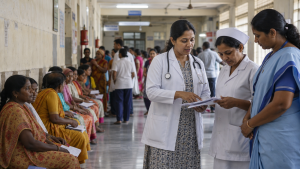
India’s health governance works through a federal structure in which public health is mainly a State responsibility, while the Union government sets policy, standards and national programmes. For prelims revision, the key is to understand how constitutional entries, the Union Ministry of Health and Family Welfare, and major agencies fit together.
Constitutional Basis of Health Governance
- State List, Entry 6: Public health, sanitation, hospitals and dispensaries are primarily under State government jurisdiction.
- Concurrent List, Entries 20, 23 and 26: Economic and social planning, population control and family planning, and medical education are shared areas of authority.
- Union List, Entries 28 and 66: Port quarantine, mental quarantine, and coordination and determination of standards in institutions for higher education or research fall under the Centre.
- Federal character: States run health delivery on the ground, while the Union provides national policy direction, financing support and technical coordination.
Evolution of the Union Health Ministry
- 1947: The Ministry of Health was formed after Independence.
- 1966: A separate Department of Family Planning was created to handle population policy.
- 1977: The ministry was renamed the Ministry of Health and Family Welfare.
- 2007: The Department of Health Research was created under the ministry through an amendment to the Allocation of Business Rules.
- 2014: The Department of AYUSH was separated from MoHFW and elevated into an independent Ministry of AYUSH.
Structure of the Ministry of Health and Family Welfare
- Two departments: MoHFW functions through the Department of Health and Family Welfare and the Department of Health Research.
- Administrative leadership: Both departments are headed by senior civil service secretaries and supported by technical bodies.
- Headquarters: The ministry is located at Nirman Bhawan / Kartavya Bhawan premises in New Delhi.
Department of Health and Family Welfare
- Main role: It handles national public health policy, disease prevention, maternal and child healthcare, medical education, and national health schemes.
- Key responsibility areas: Communicable diseases, non-communicable diseases, reproductive health, and family welfare initiatives.
- DGHS: The Directorate General of Health Services functions as the technical attached wing, providing expert advice, managing central government health facilities and executing technical mandates.
Department of Health Research
- Main role: It coordinates medical research, health technology assessment and translation of scientific innovations into public health solutions.
- ICMR: The Indian Council of Medical Research functions as an autonomous body under this department.
- Importance: The department is central to biomedical research and outbreak investigation support.
Key Institutions and Regulatory Bodies
- AIIMS, PGIMER, JIPMER: These autonomous apex institutions provide tertiary care, medical education and advanced clinical research.
- National Medical Commission: It replaced the Medical Council of India under the NMC Act, 2019 and regulates medical education and standards.
- Dental Council of India, Pharmacy Council of India and Indian Nursing Council: These statutory bodies regulate professional education, licensing and conduct in their respective fields.
- FSSAI: Established under the Food Safety and Standards Act, 2006, it functions as an autonomous statutory body under MoHFW.
- CDSCO: The Central Drugs Standard Control Organisation oversees drug approvals, clinical trial sanctions and related regulation.
- DCGI: The Drugs Controller General of India heads CDSCO under DGHS.
- National Health Authority: It replaced the National Health Agency in 2019 and implements Ayushman Bharat PM-JAY and the Ayushman Bharat Digital Mission.
Major Health Schemes and Programmes
- Ayushman Bharat: The flagship programme combines Health and Wellness Centres with PM-JAY.
- Health and Wellness Centres: These provide Comprehensive Primary Health Care, including free essential drugs and diagnostic tests at community level.
- PM-JAY: The scheme offers cashless health cover up to Rs 5 lakh per family per year for secondary and tertiary hospitalisation for vulnerable households.
- National Health Mission: It brings together the National Rural Health Mission, launched in 2005, and the National Urban Health Mission, launched in 2013.
- NHM focus: It supports Reproductive, Maternal, Newborn, Child and Adolescent Health, vector-borne disease control, NCD interventions and health infrastructure.
- Mission Indradhanush: The programme seeks full immunization coverage for children and pregnant women against vaccine-preventable diseases.
- National Tuberculosis Elimination Programme: It aims to eliminate TB through early diagnosis, active case finding, treatment and financial support under Nikshay Poshan Yojana.
- National AIDS Control Programme: Implemented under NACO, it works to reduce new infections and expand anti-retroviral treatment.
Policy Framework and Digital Health
- National Health Policy, 2017: It advocates increasing public health spending to 2.5% of GDP.
- Primary care emphasis: The policy recommends directing two-thirds or more of public health resources to primary healthcare services.
- Digital integration: It supports an integrated digital health infrastructure across primary, secondary and tertiary care.
- Ayushman Bharat Digital Mission: It creates Ayushman Bharat Health Accounts, digital registries for doctors and facilities, and personal health records.
- Interoperability: ABDM is designed to enable nationwide health data interoperability.
High-yield fact: Public health and sanitation are in Entry 6 of the State List, while medical education and population control are shared subjects under the Concurrent List.
Key Prelims Takeaways
- State List Entry 6: Public health, sanitation, hospitals and dispensaries are State subjects.
- MoHFW has two departments: Health and Family Welfare, and Health Research.
- DGHS: It is the technical attached wing of the Department of Health and Family Welfare.
- ICMR: It functions under the Department of Health Research.
- NMC: It replaced the Medical Council of India under the NMC Act, 2019.
- NHA: It implements PM-JAY and ABDM.
- FSSAI: It is an autonomous statutory body under MoHFW created under the Food Safety and Standards Act, 2006.
Current General Studies comprises current-affairs-based, General Studies-rich study material on policies, laws, institutions, economy, science, environment, governance, international relations, and other varied but important topics for UPSC and State PSC Prelims examinations.
Fortnightly PDF compilations: Available here
Originally written on
May 4, 2026
and last modified on
September 6, 2026.
| Related | |
|---|---|