Cryogenic and Low-Temperature Technologies
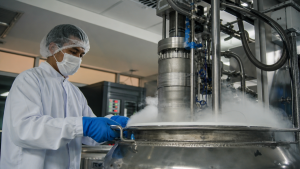
Cryogenic and low-temperature technologies deal with materials and processes at extremely cold temperatures, where ordinary physical behavior changes sharply. These systems are important in space, defence, medicine, energy, electronics and quantum research because they make it possible to liquefy gases, preserve sensitive materials and operate specialised devices.
Understanding Cryogenics
Cryogenics is the branch of physics and engineering concerned with the production and behavior of materials at very low temperatures. In practice, the term usually refers to temperatures below the liquefaction point of common gases such as oxygen and nitrogen. The field is closely linked to refrigeration, material science and superconductivity.
The lower the temperature, the more significant the changes in molecular motion and thermal properties. At the extreme end is absolute zero, or 0 Kelvin (-273.15°C), the theoretical lowest possible temperature. While it cannot be reached in practice, many cryogenic systems are designed to approach it for specialised scientific work.
Principles of Low-Temperature Generation
Reaching cryogenic temperatures requires methods that remove heat efficiently from gases, liquids or solids. Several techniques are especially important in laboratories and industrial systems.
- Joule-Thomson Effect: A gas cools when it expands from a high-pressure region to a low-pressure region through a valve or porous plug, provided it is non-ideal. This principle is widely used in liquefaction plants for gases such as nitrogen and oxygen.
- Adiabatic Demagnetization: This method can produce temperatures below 1 Kelvin. A paramagnetic material is first magnetized and then demagnetized without heat exchange, lowering its temperature further.
- Dilution Refrigeration: This system achieves ultra-low temperatures in the millikelvin range, sometimes a few mK. It uses a mixture of Helium-3 and Helium-4, where Helium-3 atoms absorb heat as they dilute into the Helium-4-rich phase.
- Millikelvin (mK): One-thousandth of a Kelvin. Such temperatures are crucial for quantum computing and other advanced research.
Why These Temperatures Matter
At cryogenic temperatures, materials behave in ways that are useful for advanced technologies. Electrical resistance can fall dramatically, some metals become superconducting, and certain gases can be stored and transported in liquid form. The controlled management of these conditions has become central to many strategic and scientific systems.
- Superconductivity: Cryogenic cooling allows materials to carry current with negligible resistance in specially designed environments.
- Gas liquefaction: Cooling gases into liquid form reduces volume and makes storage and transport more efficient.
- Precision control: Low temperatures are necessary for experiments and devices that cannot function reliably at room temperature.
- Material preservation: Biological and chemical samples can be stored safely for long periods with minimal degradation.
Applications of Cryogenic Technologies
Cryogenic systems are used across several sectors, from launch vehicles to hospitals and research laboratories. Their role is not limited to cooling; they are often enabling technologies for performance, efficiency and preservation.
- Space technology: Cryogenic fuels such as liquid hydrogen and liquid oxygen are used in rocket engines because they offer high performance and efficiency. Cryogenic cooling is also important for sensitive satellite and telescope instruments.
- Medical field: Cryosurgery uses extreme cold to destroy abnormal or diseased tissue. Cryopreservation helps store blood, tissues and embryos for long periods. MRI machines also rely on superconducting magnets cooled by liquid helium.
- Energy sector: Liquefied Natural Gas (LNG) is natural gas cooled to -162°C, reducing its volume for easier transport and storage. Cryogenic conditions are also used in superconducting power systems.
- Electronics and research: Quantum computers, superconducting devices and particle accelerators often require extremely low temperatures to function properly and maintain stability.
- Food preservation: Flash freezing with liquid nitrogen helps preserve taste, texture and nutrients better than many conventional freezing methods.
- Strategic systems: Cryogenic engineering supports advanced propulsion, high-efficiency electronics and research platforms with military and dual-use relevance.
Cryogenic Fuels
Cryogenic fuels are liquefied gases stored at very low temperatures. They are valued for their high specific impulse, meaning they can produce more thrust per unit of propellant mass than many other propellants.
- Liquid Hydrogen (LH2): Used as a fuel and stored at -253°C (20 K). It has very low molecular weight and offers high efficiency.
- Liquid Oxygen (LOX): Used as an oxidizer with liquid hydrogen or kerosene. It is stored at -183°C (90 K).
- Liquid Methane (CH4): Gaining interest as a rocket fuel, stored at -161°C (112 K). It is often discussed for reusability and ease of production.
India’s Geosynchronous Satellite Launch Vehicle (GSLV) series uses a cryogenic upper stage, demonstrating the strategic importance of mastering this technology. Such systems are technically demanding because they require stable storage, precise insulation and reliable ignition at ultra-low temperatures.
India’s Advancements in Cryogenics and Quantum Technology
India has invested in cryogenic technology mainly through the Indian Space Research Organisation (ISRO), which developed the indigenous cryogenic engine CE-7.5 for the GSLV program. This capability is significant because cryogenic propulsion is one of the most complex areas in launch vehicle engineering.
The Defence Research and Development Organisation (DRDO), functioning under the Ministry of Defence, also supports advanced low-temperature research. Its Solid State Physics Laboratory (SSPL) is involved in materials and device development for strategic applications, including those requiring extremely low temperatures. Dr. Meena Mishra assumed charge as Director of SSPL on October 1, 2023.
India’s National Quantum Mission (NQM) was approved by the Union Cabinet on April 19, 2023, with a total cost of ₹6003.65 crore for 2023-24 to 2030-31. The mission recognises the need for ultra-low-temperature infrastructure such as dilution refrigerators for quantum computing platforms. It also supports wider capability building in advanced manufacturing and deep-tech innovation.
Key Prelims Takeaways
- Cryogenics: Study of extremely low temperatures, generally below -150°C (123 K).
- Absolute zero: 0 Kelvin or -273.15°C, the theoretical lowest temperature.
- Joule-Thomson effect: Cooling of a gas during expansion from high pressure to low pressure.
- Adiabatic demagnetization: Used to reach temperatures below 1 Kelvin.
- Dilution refrigerator: Cryogenic system for millikelvin temperatures, important in quantum technologies.
- LH2 and LOX: Important cryogenic propellants used in space launch systems.
- NQM: Approved on April 19, 2023, with an outlay of ₹6003.65 crore for 2023-24 to 2030-31.
- GSLV: India’s launch vehicle series that uses a cryogenic upper stage.
- DRDO and SSPL: Key institutions supporting strategic low-temperature and materials research.
Recent Context
On September 24, 2026, DRDO signed its first high-value deep-tech project agreement under the Technology Development Fund scheme with Zero mK India Private Limited for indigenous development of a 20 mK dilution refrigerator. The project is part of a ₹500 crore corpus for deep-tech and cutting-edge work and aligns with the National Quantum Mission.
| Related | |
|---|---|