Important Indigenous Cattle and Buffalo Breeds of India
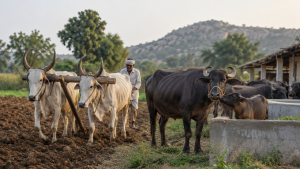
India’s indigenous cattle and buffalo breeds support milk production, draught work and rural livelihoods. Their adaptation to local climates, feed and disease environments makes their conservation important for biodiversity, climate-resilient agriculture and sustainable livestock development.
Importance of Indigenous Breeds
- Heat tolerance: Zebu cattle (Bos indicus) are adapted to tropical and subtropical conditions.
- Resilience: Many native breeds tolerate local diseases and parasites, use low-quality roughage and remain productive across varied terrain and nutritional conditions.
- Multiple uses: Dual-purpose breeds provide milk as well as draught power for farming and transport, particularly valuable to small farmers.
- Genetic and dairy value: Indigenous breeds contribute to bovine genetic diversity and are known predominantly for A2 beta-casein milk. Potential health benefits are often claimed, but should not be treated as established solely on that basis.
Important Indigenous Cattle Breeds
India has 43 registered indigenous cattle breeds, traditionally classified as milch, draught or dual-purpose according to their primary utility.
- Sahiwal and Gir: Sahiwal, from Punjab and Rajasthan, is docile, reddish-brown and heat tolerant; its average yield is about 2,326 kg per lactation. Gujarat’s Gir is recognisable by its convex forehead and long, pendulous ears, and yields around 2,000–3,000 kg per lactation.
- Red Sindhi and Rathi: Red Sindhi cattle, originally from the Sindh region and also found in India, have a deep-red coat and produce about 6–12 litres of milk daily. Rajasthan’s Rathi is adapted to arid conditions and yields around 1,500–2,500 kg per lactation.
- Tharparkar and Kankrej: Tharparkar cattle, associated with the arid regions of Rajasthan, are robust and white to light grey; reported yields are about 1,800–2,500 kg per lactation. Kankrej cattle from Gujarat and Rajasthan are strong draught animals; cows may produce 5–10 litres daily.
- Ongole and Hariana: Coastal Andhra Pradesh’s Ongole is a large, powerful draught breed, with average milk yield of about 798 kg per lactation. Hariana cattle, from Haryana and surrounding regions, are white or light grey and used for work and moderate milk production.
- Amritmahal and Deoni: Karnataka’s Amritmahal is a prominent draught breed, historically valued for fast road work. Deoni, found in Maharashtra’s Marathwada region and parts of Karnataka, is used for both draught and dairy purposes.
- Dangi and Khariar: Maharashtra’s Dangi is suited to hilly, high-rainfall areas and valued for agricultural work. Odisha’s Khariar is used for both milk and draught power and is adapted to eastern Indian conditions.
Important Indigenous Buffalo Breeds
India has 13 registered indigenous buffalo breeds. Buffalo milk is valued for its high fat content and use in dairy products.
- Murrah: A major dairy breed from Haryana and Punjab, it is jet black with tightly curled horns. Its reported yield is about 1,500–2,500 kg per lactation, with milk fat of around 7.83%.
- Nili-Ravi and Jaffarabadi: Nili-Ravi, found mainly in Punjab, is known for high milk production and white markings on the forehead, face and legs. Gujarat’s Jaffarabadi is a large, powerful breed noted for good milk yield.
- Mehsana and Surti: Mehsana, found in Gujarat and adjoining Maharashtra, developed from Surti–Murrah crossbreeding and produces around 1,200–1,500 kg per lactation. Surti, from Gujarat’s Kaira and Baroda districts, has sickle-shaped horns and milk with high fat and solids-not-fat (SNF) content.
- Bhadawari, Nagpuri and Chilika: Bhadawari, from areas around the Yamuna, Chambal and Utangan rivers, is known for milk fat of about 8–10% and use of low-quality fodder. Maharashtra’s Nagpuri is adapted to hot, dry conditions and produces around 4–7 litres daily. Odisha’s Chilika is adapted to feeding on aquatic vegetation in salty waters and is used for milk, manure and draught work.
Breeding, Conservation and Government Initiatives
Improving productivity while conserving indigenous breeds requires reliable breeding services, genetic records and appropriate breeding methods.
- Rashtriya Gokul Mission (RGM): Launched in December 2014 as a Central Sector Scheme, RGM supports indigenous bovine breed development and conservation, genetic upgradation, higher milk productivity and modern breeding technologies. Its measures include Gokul Grams, the National Kamdhenu Breeding Centre, sex-sorted semen, IVF and the E-Pashu Haat – Nakul Prajnan Bazaar e-market portal.
- RGM funding and recognition: Restructured in July 2021 for 2021–22 to 2025–26, the mission’s outlay was revised from ₹2,400 crore to ₹3,400 crore in March 2025. The National Gopal Ratna Award, instituted under RGM in 2021, recognises farmers rearing indigenous livestock, dairy cooperative societies and Artificial Insemination Technicians.
- NPBBDD: Launched in February 2014 by merging four schemes, the National Programme for Bovine Breeding and Dairy Development integrates breeding and dairy development. The National Programme for Bovine Breeding expands Artificial Insemination networks, supports indigenous breed conservation and breeders’ associations; the National Programme for Dairy Development supports milk production, procurement, processing and marketing infrastructure.
- Breeding methods: Artificial insemination uses collected semen that may be extended, cooled or frozen for on-site use or shipment to a female animal’s location. It can help control offspring paternity and avoid keeping fertile males where they are difficult to manage. Genomic selection estimates breeding value from genome-wide markers, allowing selection at younger ages; bull progeny testing instead assesses inherited merit through daughters’ milk records and takes longer.
Key Prelims Takeaways
- India has 43 registered indigenous cattle breeds and 13 registered indigenous buffalo breeds.
- Indigenous Bos indicus cattle characteristically have a hump, loose skin and a dewlap.
- Sahiwal and Gir are prominent indigenous dairy cattle breeds; Murrah is a major dairy buffalo breed.
- RGM, launched in 2014, focuses on indigenous bovine breed conservation and genetic improvement.
- Gokul Grams are integrated indigenous cattle centres; E-Pashu Haat is an e-market portal for breeders and farmers.
- NPBBDD links bovine breeding with dairy development and infrastructure.
Recent Context
On November 9, 2026, the Odisha Cabinet approved the draft Odisha Bovine Breeding (Regulation) Bill, 2026, for introduction in the Assembly’s winter session beginning November 18. It proposes registration and oversight of breeding services, a digital livestock registry and a genetic improvement fund to support scientific breeding and conservation of indigenous breeds.
| Related | |
|---|---|