Traditional Agricultural and Commercial Practices in India
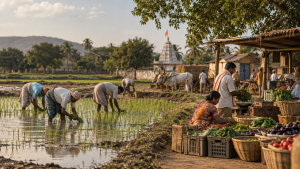
Traditional agricultural and commercial practices in India reflect locally developed knowledge shaped by climate, seasons and community life. They connect agrarian livelihoods with festivals, water management, rural markets and systems of exchange, while offering insight into traditional knowledge and rural economic practices.
Traditional Agricultural Calendar Systems
India’s agricultural activities have long been linked to traditional calendars, many of which are lunisolar. The Vikram Samvat is widely used, particularly in western India. Although its year commonly begins with Chaitra Shukla Pratipada in March–April, the Gujarati agricultural and accounting year traditionally begins on Kartik Shukla Pratipada, the day after Diwali. Bestu Varas, the Gujarati New Year, marks this beginning; farmers traditionally open their new accounting books on the day. Lunisolar calendars require adjustments to remain aligned with the solar year. In the Vikram Samvat, an extra lunar month, called Adhika Masa or Malmas, is incorporated approximately seven times in nineteen years. This helps keep months, festivals and crop-related rituals aligned with the seasons. The Saka Samvat, with an epoch corresponding to 78 CE, was adopted as India’s national calendar in 1957. It is used alongside the Gregorian calendar in official government communications and news broadcasts. Traditional calendars help communities determine timings for sowing, harvesting and observing agrarian festivals.
Crop Cycles and Associated Festivals
India’s main crop seasons are Kharif, Rabi and Zaid. Their timing varies by region and local conditions, but the broad seasonal pattern links cultivation with monsoon and winter rainfall.
- Kharif: Monsoon crops are generally sown in June–July and harvested in September–October. Rice, maize, jowar, bajra, tur (pigeon pea), groundnut and cotton are important Kharif crops. Onam in Kerala and Nuakhai in Odisha are associated with the harvest.
- Rabi: Winter crops are generally sown between October and December and harvested from April to June. Wheat, barley, oats, gram, mustard and linseed are among the major crops. Baisakhi in Punjab, Pongal in Tamil Nadu and Makar Sankranti, observed under regional names including Lohri and Magh Bihu, are linked to harvest celebrations.
- Zaid: This shorter season falls between Rabi and Kharif, typically from March to June. It supports crops such as watermelon, muskmelon and cucumber, as well as fodder crops.
Agrarian festivals mark stages of the cultivation cycle, celebrate harvests and express hopes for prosperity. They also reflect the close relationship between farming, local culture and community life.
Indigenous Farming Practices and Water Management
Traditional farming practices draw on local conditions and resources. Their methods can support soil health, crop diversity and the management of risks, although their effectiveness depends on local circumstances.
- Mixed cropping: Growing two or more crops together on the same plot can diversify production and reduce the risk of total crop loss.
- Crop rotation: Growing different crops in sequence can support soil health, manage pests and make use of soil nutrients.
- Organic manuring: Farmyard manure, compost and green manure are used to add organic matter and nutrients to soil.
- Seed preservation: Saving seed from selected harvests helps maintain locally adapted varieties and crop genetic diversity.
- Natural pest management: Neem-based preparations, companion planting and biological control are among the methods used to manage pests.
- Jhum cultivation: Practised by some communities in Northeast India, this form of shifting cultivation involves clearing land temporarily and moving cultivation as plots are left to regenerate.
- Terrace farming: Used in hilly areas, terraces create level plots on slopes, help limit soil erosion and support cultivation, including rice.
Traditional water systems reflect adaptation to local terrain and rainfall.
- Ahar-Pyne: Used in South Bihar, pynes are diversion channels that carry water, including floodwater, to embanked reservoirs called ahars.
- Kuhl: These gravity-flow channels in the Western Himalayan region divert water from glaciers and streams for irrigation.
- Johads: Earthen check dams, found in Rajasthan and other arid areas, capture rainwater and can help recharge groundwater.
- Tank irrigation: Small reservoirs or tanks store monsoon rainwater for agricultural use, particularly in peninsular India.
- Paar system: Practised in western Rajasthan, this rainwater-harvesting method relies on water percolating through sandy soil and being accessed through shallow wells called kuis or beris.
Traditional Commercial and Economic Practices
Local markets, community relationships and instruments of credit shaped many traditional rural and commercial economies.
- Chopda Pujan: Business communities ceremonially open new account books on the New Year or sometimes on Diwali night. The practice is especially associated with western India and the start of a new financial year.
- Hundi: An indigenous credit instrument and traditional bill of exchange, the hundi facilitated trade, remittances and credit transfers across distances without physical movement of currency. It directed payment of a specified sum to a named person.
- Haats: Weekly or bi-weekly rural markets enabled the exchange of agricultural produce, handicrafts and everyday goods, serving as hubs for local economic activity.
- Jajmani system: A historical arrangement of hereditary occupational and economic ties in village society. Service-providing groups supplied specialised work to jajmans, often landowning or upper-caste families, in return for grain, goods or land use. It created interdependence within a hierarchical social structure.
- Shrenis: Guilds of artisans and merchants regulated aspects of trade, maintained quality standards and could provide social support to members.
These practices show how rural economic activity was embedded in social relationships and seasonal cycles. They also raise questions about how traditional knowledge can inform sustainable livelihoods while recognising the inequalities built into some historical institutions.
Key Prelims Takeaways
- Vikram Samvat: A prominent lunisolar calendar; its extra lunar month is added about seven times in nineteen years.
- Saka Samvat: India’s national calendar, adopted in 1957, with an epoch corresponding to 78 CE.
- Bestu Varas: Gujarati New Year on Kartik Shukla Pratipada, marking the beginning of the agricultural year.
- Crop seasons: Kharif is monsoon, Rabi is winter and Zaid is the short summer season.
- Water systems: Ahar-Pyne is associated with South Bihar; kuhl channels with the Western Himalayas; johads with rainwater harvesting in arid regions.
- Commercial practices: Hundi refers to an indigenous credit instrument; haats are periodic rural markets; Chopda Pujan is the opening of new account books.
Recent Context
The recent observance of Bestu Varas on Kartik Shukla Pratipada marked the start of Vikram Samvat 2083. The occasion reflects the continuing connection between the Gujarati agricultural year and commercial customs, including farmers’ opening of new accounting books and business communities’ Chopda Pujan.
| Related | |
|---|---|