Emerging Technologies Used in Border Security
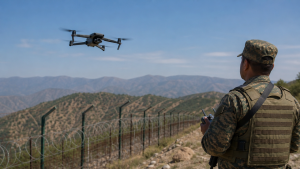
Emerging technologies combine surveillance, identification, data analysis and deterrence to help authorities monitor complex border environments. They can improve situational awareness and response, but their adoption also raises governance and human-rights questions, particularly where systems affect people’s movement or physical safety.
Advanced Surveillance and Monitoring
Surveillance systems collect information across large or difficult-to-access areas, helping border agencies detect and assess activity. Sensors and cameras can send alerts to control centres, where officers decide whether and how to respond.
- Unmanned aerial vehicles (UAVs): Drones carrying high-resolution cameras, thermal imaging or radar provide aerial reconnaissance over extensive areas and difficult terrain.
- Ground sensors: Seismic, acoustic, magnetic and infrared sensors detect movement, vibrations or heat signatures and can trigger alerts.
- Aerostats and towers: Tethered aerostats and elevated towers can carry radar, optical and thermal cameras for persistent, wide-area observation.
- Satellite imagery and geospatial intelligence (GEOINT): Satellite images support broad-area monitoring and mapping, including the identification of changes in terrain, infrastructure and potential crossing routes.
- Radar systems: Ground-based systems, including Vehicle-Mounted Surveillance Systems (VMSS) and fixed-tower radars, detect moving people or vehicles over long distances, including in low visibility.
Biometric Identification Systems
Biometrics support identity verification and screening at ports of entry. They use physiological or behavioural characteristics to compare a person’s identity with available records or watchlists. Their use in border operations makes the accuracy and appropriate handling of identity information important considerations.
- Fingerprint scanners: Used at checkpoints to compare fingerprints against databases and watchlists.
- Facial recognition: Algorithms identify or verify people from images or video; systems may be integrated with surveillance cameras to screen crowds.
- Iris scanners: Identify individuals by analysing distinctive iris patterns and may be used in high-security settings.
- Voice and vein recognition: Voice analysis can provide supplementary verification, while vein-pattern systems scan blood-vessel patterns beneath the skin.
Artificial Intelligence and Data Analytics
Artificial intelligence (AI) and machine learning can process data from multiple sensors and information systems. They support detection and analysis, but their outputs are tools for operational decision-making rather than substitutes for accountable human judgement.
- Predictive analytics: Historical data, migration patterns and intelligence reports can be analysed to estimate possible entry points or times and help direct resources.
- Anomaly detection: Systems can flag unusual patterns in sensor data, video feeds or biometric scans for further assessment.
- Automated target recognition: Computer vision can detect and classify objects such as people or vehicles in surveillance footage.
- Data fusion: Correlating information from sources such as radar, thermal cameras and customs databases can produce a more comprehensive operational picture.
- Natural language processing: NLP can help analyse large volumes of text, including intelligence reports, to identify relevant information.
Robotics, Barriers and Deterrence
Robotic platforms can assist with patrols, surveillance and logistics in remote or hazardous locations. Sensor-equipped barriers and non-lethal devices add detection or warning functions, but operational choices still require clear oversight.
- Unmanned ground vehicles (UGVs): Ground robots can patrol difficult terrain and carry sensors, reducing the need to expose personnel to some hazards.
- Autonomous patrol vehicles: Sensor- and camera-equipped vehicles can conduct routine patrols along fixed routes.
- Remotely operated vehicles (ROVs): Underwater drones can support maritime surveillance and inspection of vessels or infrastructure.
- Integrated barriers and acoustic devices: Fencing may incorporate fibre optics or seismic detectors to identify attempted breaches. Long-Range Acoustic Devices (LRADs) can transmit warnings or directional sound over long distances.
Active Denial System: Uses and Oversight
The Active Denial System (ADS) is a directed-energy system that emits an invisible beam of electromagnetic energy. It heats the skin’s surface, producing an intense burning sensation without physical contact. The intended effect is to make a person move away from the beam; the sensation typically lasts 10 to 15 minutes. Its reported range is slightly more than half a mile. The US military previously deployed ADS to Afghanistan, but it was not used in combat. Officials also considered it for crowd control at facilities holding terrorist detainees abroad, but did not proceed. Earlier discussions included its possible use to discourage crossings near a river or move people out of the water. The system’s effects make governance and human-rights protection central to any decision about testing or use. Concerns include effectiveness, legality and the risk of harm. A person moving away from the beam could enter dangerous terrain or water, creating risks of indirect injury and the need for rescue. Border agencies therefore need clear operating procedures, oversight and consideration of foreseeable consequences.
Key Prelims Takeaways
- Surveillance: UAVs, ground sensors, aerostats, towers, satellites and radar support border monitoring.
- Biometrics: Common modalities include fingerprints, facial and iris recognition, voice analysis and vein patterns.
- AI applications: Predictive analytics, anomaly detection, automated target recognition, data fusion and NLP support analysis.
- Robotics: UGVs, autonomous patrol vehicles and underwater ROVs can assist surveillance and logistics.
- ADS: It is a directed-energy system; its reported range is slightly more than half a mile, and the sensation typically lasts 10 to 15 minutes.
- US border governance: Customs and Border Protection (CBP) is a federal agency under the Department of Homeland Security (DHS).
Recent Context
On October 22, 2026, the Pentagon authorized DHS to test an ADS for possible use along the US–Mexico border. A September memo permits DHS to borrow one unit for seven months; the testing location and any eventual deployment remain unspecified. DHS is responsible for operation and procedures.
| Related | |
|---|---|