Growth of Women’s Football in India
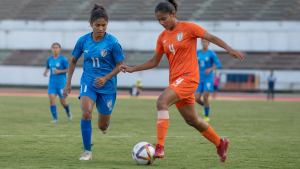
Women’s football in India has developed through national organisation, domestic competition and growing international participation. Its continued progress depends on strengthening the pathway from grassroots training to professional clubs and national teams, while improving access to infrastructure and opportunities for women.
Early Development and Milestones
Organised women’s football gained momentum in the 1970s. The Women’s Football Federation of India (WFFI), established in 1975, organised early tournaments and helped promote the game nationally. The first National Women’s Football Championship was held that year in Lucknow, Uttar Pradesh. The WFFI merged with the All India Football Federation (AIFF) in 1991, bringing women’s football under the national governing body. India hosted the AFC Women’s Championship in 1980 and 1983, finishing as runner-up in 1983. These early milestones established a national competition structure and gave Indian players opportunities to compete at the continental level.
AIFF and the Development Framework
The AIFF governs football in India and is affiliated with FIFA and the Asian Football Confederation (AFC). Its responsibilities include national team activities, domestic competitions and player development.
- National planning: The AIFF’s Vision 2047 sets out plans for the broader development of Indian football, including goals for the women’s game.
- Technical capacity: Increasing the number of technical staff and coaches is part of developing women’s football and supporting players across different stages of their careers.
- Competition pathway: National tournaments and the Indian Women’s League provide structures through which players can gain competitive experience and progress towards higher levels of the game.
A coherent pathway requires coordination between governing bodies, clubs, state-level programmes and training institutions. Sustained investment in coaching and facilities can help make participation more accessible and support the transition from grassroots football to elite competition.
Indian Women’s League
The Indian Women’s League (IWL) is India’s top-tier professional club competition for women. The AIFF launched it in 2016, and its inaugural season was held in Cuttack, Odisha, in 2017. Rising Student’s Club won the first title.
- Competitive platform: The league gives clubs from across India a national competition in which players can test themselves against stronger opposition.
- Format: The competition has typically used group-stage and knockout rounds, with participating clubs drawn from different parts of the country.
- Professional opportunities: The league has expanded its reach and offers women players opportunities to secure professional contracts.
- Continental route: The IWL winner has a route to represent India in the AFC women’s club competition, now known as the AFC Women’s Champions League.
A regular club season can help players gain match experience beyond national-team camps. The league’s impact also depends on clubs having adequate coaching, facilities and financial support to sustain teams and provide meaningful competition.
National Team and International Competitions
The Indian women’s national team, known as the Blue Tigresses, competes in regional and continental tournaments. India has won the SAFF Women’s Championship multiple times, making the competition an important platform for regional rivalry and international match experience. India hosted the AFC Women’s Asian Cup in 2022. Matches were held in Navi Mumbai, Pune and Bhubaneswar. Hosting a major tournament brought international women’s football to Indian venues and gave local audiences an opportunity to watch teams from across Asia. The AFC Women’s Champions League, launched in the 2024–25 season, has a preliminary stage, a 12-team group stage and a knockout stage. For its first four seasons, through 2027–28, each participating association is allotted one entry. Entry allocation combines club performance with the most recent FIFA Women’s World Ranking.
- Weighting through 2027–28: Club points account for 70% and national-team points for 30% of the ranking used for entry allocation.
- From 2028–29 to 2029–30: The weighting is scheduled to shift to 90% club points and 10% national-team points.
- From 2030–31: The ranking is scheduled to be based entirely on club points.
These changes place increasing emphasis on club performance in determining entry allocation. Participation in international club competitions can also expose Indian players and teams to different styles of play and higher levels of competition.
Support, Inclusion and Capacity Building
Government bodies, football institutions, state governments and corporate partners all contribute to the development of women’s football. Khelo India, launched by the Ministry of Youth Affairs and Sports, promotes grassroots sports development and the identification of young talent. Its support for women’s sport can encourage girls to enter football academies and competitions. Sports Authority of India (SAI) training centres provide infrastructure and coaching facilities for women footballers. State governments also support the game through state-level leagues and talent-development programmes, while corporate sponsorships and partnerships can provide financial support to teams and tournaments.
- Grassroots capacity: Early access to coaching and competitions helps young players build skills and progress through the football pathway.
- Sports infrastructure: Training facilities and suitable playing opportunities are important for consistent participation and player development.
- Gender inclusion: Expanding access to academies, leagues and professional opportunities can strengthen women’s participation in the sport.
- Long-term development: Coordination among schools, state programmes, clubs and the AIFF can connect grassroots participation with elite competition.
Key Prelims Takeaways
- WFFI was established in 1975; the first National Women’s Football Championship was held in Lucknow that year.
- The WFFI merged with the AIFF in 1991.
- India hosted the AFC Women’s Championship in 1980 and 1983, finishing runner-up in 1983.
- The AIFF launched the IWL in 2016; its inaugural 2017 season was won by Rising Student’s Club.
- India hosted the 2022 AFC Women’s Asian Cup in Navi Mumbai, Pune and Bhubaneswar.
- Khelo India and SAI contribute to grassroots development, training and facilities.
Recent Context
On November 1, 2026, East Bengal FC beat Vietnam’s Ho Chi Minh City Women’s FC 2–1 in its AFC Women’s Champions League 2026–27 Group B opener in Kolkata. The victory made East Bengal the first Indian club to record multiple group-stage wins in the competition; it had beaten Iran’s Bam Kho Toon FC 3–1 in 2025–26.
| Related | |
|---|---|