Important Traditions and Rituals Associated with Indian Festivals
Indian festivals follow regional calendars and reflect religious beliefs, agricultural cycles and community life. Their rituals range from worship and fasting to feasts, processions and seasonal celebrations, sustaining living heritage and passing cultural practices between generations.
Calendrical Systems and New Year Observances
- Vikram Samvat: A lunisolar calendar widely used in northern, western, central and eastern India, and in Nepal. Its epoch is 57 BCE; the year generally begins on Chaitra Shukla Pratipada, in March or April.
- Saka Samvat and regional New Years: Adopted as India’s national calendar in 1957, the Saka era has an epoch of 78 CE and begins on Chaitra 1—March 22, or March 21 in leap years. Gudi Padwa and Ugadi fall on Chaitra Shukla Pratipada; Baisakhi, Pohela Boishakh, Puthandu and Vishu mark New Year or seasonal transitions in their respective regions.
Shared Rituals and Social Significance
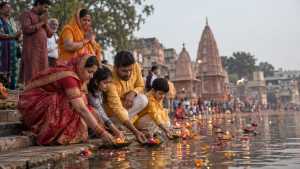
- Worship and offerings: Pujan involves prayers and offerings to deities; aarti is performed by waving a lamp. Prasad, food offered during worship, is distributed among devotees.
- Fasting and festive symbols: Vrat is observed as an act of devotion or to seek blessings. Rangoli and Alpana patterns, made with materials such as coloured powders, flowers or rice paste, decorate entrances; lamps are especially prominent during Diwali.
- Collective observances: Melas bring together performances, crafts and local food, while processions may carry deity idols or chariots through streets. Shared rituals and meals strengthen social cohesion and help transmit cultural practices.
Major Festivals and Their Rituals
- Diwali: This five-day festival includes Dhanteras, associated with worship of Lakshmi and Kubera and auspicious purchases; Naraka Chaturdashi, recalling Krishna’s defeat of Narakasura; Lakshmi Pujan; Govardhan Puja; and Bhai Dooj, when sisters pray for their brothers’ well-being.
- Holi: Holika Dahan, a bonfire associated with the story of Prahlad and Holika, precedes Rangwali Holi, when people play with colours and water. Gujiya is among the traditional sweets prepared for the festival.
- Navaratri and Dussehra: Navaratri’s nine nights include regional forms of worship, Durga Puja in eastern India and Kanya Pujan, in which young girls are honoured as embodiments of the Goddess. Vijayadashami commemorates Rama’s victory over Ravana; effigies of Ravana and his allies are burnt in some traditions.
- Eid al-Fitr, Christmas and Guru Nanak Jayanti: Eid al-Fitr follows Ramadan and features congregational prayers, Zakat al-Fitr charity, greetings and shared meals. Christmas commemorates Jesus Christ’s birth with church services, carols and Nativity displays. Sikh observances for Guru Nanak include Akhand Path, Nagar Kirtan led by the Panj Pyare and langar open to all.
Regional Traditions
- Pongal: Tamil Nadu’s four-day harvest festival includes Bhogi, when old possessions may be discarded; Surya Pongal, when newly harvested rice is cooked in honour of the Sun; Mattu Pongal, which honours cattle; and Kaanum Pongal, associated with family gatherings.
- Onam: Kerala’s harvest festival features Pookalam floral carpets, Onam Sadya served on banana leaves, Pulikali performances and Vallam Kali boat races.
- Bihu: Assam observes Rongali or Bohag Bihu as a spring festival and New Year, Kongali or Kati Bihu around the completion of sowing and rice transplantation, and Bhogali or Magh Bihu as a harvest celebration with bonfires and community feasts.
Bestu Varas and Related Observances
- Gujarati New Year: Bestu Varas, also called Kartak Sud Ekam, falls on Kartik Shukla Pratipada, the day after Diwali. It marks the beginning of a new Vikram Samvat year and, for many, the agricultural and accounting year. People visit temples, pray, wear new or traditional clothes and exchange greetings such as “Saal Mubarak” and “Nutan Varshabhinandan”.
- Chopda Pujan: Business communities worship new account books, traditionally on the New Year or sometimes on Diwali night. Ledgers may be marked “Shubh” and “Labh” and with a Swastika; prayers and offerings seek blessings from Ganesha, Lakshmi and Saraswati for prosperity.
- Other customs: Some households begin the day by buying salt, or “sabras”, as a symbol of a full and balanced year. In some traditions, particularly Pushtimarg, Annakut—a mountain of food—is offered to Krishna in connection with the Govardhan story.
- Diwali Padwa and Bali Pratipada: The same day is observed under these names in other regions and is associated with King Mahabali’s return to Earth and his connection with Vishnu. In Maharashtra, wives may perform aukshan for their husbands, who often give them gifts; the day is also considered auspicious for new ventures.
Key Prelims Takeaways
- Vikram Samvat has an epoch of 57 BCE; Saka Samvat has an epoch of 78 CE and is India’s national calendar.
- Bestu Varas falls on Kartik Shukla Pratipada, the day after Diwali; Chopda Pujan marks the opening of new account books.
- Diwali includes Lakshmi Pujan; Holi includes Holika Dahan and Rangwali Holi.
- Navaratri culminates in Vijayadashami; Pongal is a four-day Tamil Nadu harvest festival.
- Onam features Pookalam and Vallam Kali; Assam’s Bihu observances include Rongali, Kongali and Bhogali.
- Adhika Maas, an intercalary month in lunisolar calendars, helps align the calendar with the seasons.
Recent Context
Gujarati communities marked Bestu Varas, the beginning of Vikram Samvat 2083, on Tuesday, 10 November 2026, two days after Diwali on 8 November. Temple visits, family greetings and Chopda Pujan were among the observances.
Current General Studies comprises current-affairs-based, General Studies-rich study material on policies, laws, institutions, economy, science, environment, governance, international relations, and other varied but important topics for UPSC and State PSC Prelims examinations.
Fortnightly PDF compilations: Available here
Originally written on
November 11, 2026
and last modified on
November 11, 2026.
| Related | |
|---|---|