Scientists Study Uranus for Clues to Lost Planets
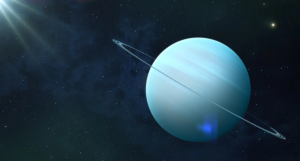
Scientists studying Uranus in June 2026 examined moon dynamics, ring structure, and planetary formation models to test whether the early Solar System contained additional giant planets that were later ejected into interstellar space. The research used simulations of the Solar System’s chaotic history and compared them with the present-day arrangement of Uranus and its moons.
Uranus and the Ice Giant Class
Uranus is the seventh planet from the Sun and one of the four outer giant planets of the Solar System. It has 29 known moons, and its major moons include Miranda, Ariel, Umbriel, Titania, and Oberon. The term “ice giant” is used for Uranus and Neptune in planetary science, although a 2026 study by Yamila Miguel and other researchers examined whether their outer shells contain large amounts of rock, hydrogen, and helium gas. Uranus has a tilted rotational axis of about 98 degrees, which makes it one of the most unusual planets in the Solar System.
Moon Simulations and Planetary History
Researchers published in Icarus tested 122 scenarios of Solar System evolution and examined whether Uranus’ moon system could survive without an additional giant planet in the early Solar System. The simulations suggested that the moon system would have been disrupted unless one or more giant planets were later removed from the system. Miranda is a key Uranian moon in such studies because its surface contains signs of past disruption and reassembly. The moons of Jupiter and Uranus are also used in comparative studies of planetary migration and orbital instability during the first 3 to 4 billion years of Solar System history.
Rings and Undiscovered Moons
Uranus has a system of narrow rings that was first discovered in 1977. Observations of the outer rings in 2026 suggested the possible presence of additional moons beyond the 29 already known, because small satellites can shape ring edges and ring gaps through gravity. Planetary rings are made of ice, dust, and rocky particles, and their structure is often influenced by nearby moons. Uranus remains the only planet whose rings were discovered from Earth-based observations before a spacecraft visited the planet.
Important Facts for Exams
- Uranus is the seventh planet from the Sun and belongs to the outer Solar System.
- Uranus has 29 known moons, including Miranda, Titania, and Oberon.
- The planet’s axial tilt is about 98 degrees, which causes extreme seasonal variation.
- Uranus’ rings were discovered in 1977 through Earth-based observations.
Uranus was visited by Voyager 2 in 1986, which remains the only spacecraft to have flown past the planet. Icarus is a peer-reviewed journal that publishes research on Solar System science and planetary formation.
| Related | |
|---|---|