NASA Rover Detects Complex Carbon Molecules on Mars
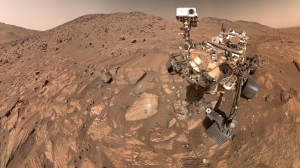
NASA’s Perseverance rover detected complex, macromolecular carbon in two Martian mudstones on 24 June 2026. The samples came from the Bright Angel outcrop in Neretva Vallis within Jezero Crater on Mars.
Perseverance Mission and Jezero Crater
Perseverance is a Mars rover operated by NASA and landed in Jezero Crater in February 2021. Jezero Crater contains an ancient lake basin and delta deposits that are used in planetary science to study past water activity on Mars.
Organic Carbon on Mars
Macromolecular carbon is a form of complex organic carbon made of large carbon-rich structures. In the Bright Angel outcrop, the organic carbon was found with silicate minerals in one mudstone and with carbonate and sulfate minerals in another mudstone. The different mineral associations indicate that the carbon-bearing materials were deposited at different times in the rock history. NASA described this as the most robust organic detection so far in Jezero Crater and the only detection of macromolecular carbon on a natural rock surface on Mars.
SHERLOC Instrument
Perseverance used SHERLOC, the Scanning Habitable Environments with Raman and Luminescence for Organics and Chemicals instrument, to study the rocks. SHERLOC is mounted on the rover’s robotic arm and uses ultraviolet Raman and fluorescence spectroscopy to identify organic compounds and minerals.
Bright Angel Outcrop and Leopard Spots
The Bright Angel outcrop was previously noted in 2024 for unusual “leopard spots” in the rock surface. Scientists had examined these spots as possible biosignatures, a term used for substances or structures that may have a biological origin.
Important Facts for Exams
- Jezero Crater on Mars is an ancient impact basin selected for rover studies because it once contained a lake environment.
- Curiosity rover detected decane and dodecane in Gale Crater in March 2025.
- Curiosity identified seven new organic molecules in a drilled sample in April 2026.
- Organic-bearing mudstones have been detected by Perseverance and Curiosity more than 3,500 kilometres apart on Mars.
Sample Return and Laboratory Analysis
Perseverance has collected samples that would require return to Earth for advanced laboratory analysis to determine the origin of the carbon compounds. NASA’s Mars Sample Return mission was effectively scrapped in January 2026.
| Related | |
|---|---|