NASA Plans Swift Boost Mission for Telescope Rescue
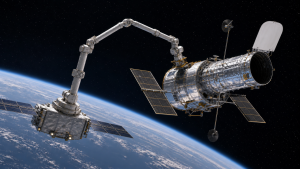
NASA is preparing the Swift Boost mission to raise the orbit of the Neil Gehrels Swift Observatory, a space telescope launched in November 2004. The observatory is losing altitude because of atmospheric drag linked to increased solar activity, and it could re-enter Earth’s atmosphere by late 2026.
Neil Gehrels Swift Observatory
The Neil Gehrels Swift Observatory is a U.S. government scientific satellite designed for astrophysical observations. It was launched in November 2004 and was not built for servicing, docking, or robotic capture by another spacecraft.
Swift Boost Mission Profile
The mission is scheduled for launch on 27 June 2026 aboard a Northrop Grumman Pegasus XL rocket. The rocket will be carried by a Stargazer aircraft that will take off from Kwajalein Atoll in the Pacific Ocean. The mission uses a robotic servicing spacecraft named LINK, developed by Arizona-based Katalyst Space Technologies. NASA awarded a $30 million contract for the project in September 2025, and the spacecraft was built in 250 days.
LINK Servicing Spacecraft
LINK has a mass of 935 pounds, or 424 kilograms. It carries reaction-control thrusters, robotic arms, and rendezvous sensors for approach, capture, and orbit-raising operations. The spacecraft is designed to approach an unprepared satellite, attach to it, and boost it into a higher orbit. The mission is a test of robotic orbital servicing for a U.S. government scientific satellite.
Important Facts for Exams
- The Neil Gehrels Swift Observatory was launched in November 2004.
- The Swift Boost mission is planned for 27 June 2026.
- The Pegasus XL rocket is carried by a Stargazer aircraft.
- Kwajalein Atoll is located in the Pacific Ocean.
Operational Timeline
Swift’s scientific observations have been paused since February 2026 to reduce drag and preserve orbit. If the mission succeeds, science operations could resume as early as autumn 2026. The mission aims to extend the observatory’s operational life by at least five years and possibly up to a decade.
| Related | |
|---|---|