Lake Laach Magma Reservoir Mapped in 3D
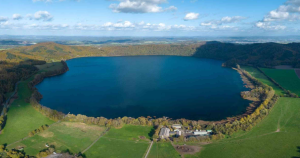
Lake Laach, also called Laacher See, is a volcanic lake in the Eifel volcanic region of western Germany. A German research team used passive seismology, microearthquake data and fibre-optic sensing to map the magma reservoir beneath the lake in three dimensions.
Lake Laach and the Eifel Volcanic Field
The Eifel volcanic field is a volcanic region in western Germany that includes Laacher See and the East Eifel Volcanic Field. The area contains Quaternary volcanic structures, and the subsurface remains thermally and mechanically active.
Eifel Large-N Experiment
Between September 2022 and August 2023, the GFZ German Research Centre for Geosciences and the University of Potsdam carried out the Eifel Large-N experiment. The deployment used more than 494 seismic stations and a 64 km fibre-optic cable, and it became the largest passive seismological deployment in Central Europe.
Subsurface Imaging and Magmatic Structure
By September 2025, researchers produced the first high-resolution 3D image of the magma reservoir beneath Lake Laach. By December 2025, they identified a deep, tilted magmatic structure beneath the Eifel volcanic region that extended from about 2 km to 10 km depth, had an estimated volume of about 75 km³, and dipped about 53° towards the south-east.
Important Facts for Exams
- Laacher See is a volcanic lake in the Eifel region of Germany.
- Passive seismology records natural seismic waves without using artificial explosions.
- Microearthquakes are very small earthquakes that are often used to study volcanic and tectonic activity.
- Fibre-optic cables can be used as distributed acoustic sensors in geophysical surveys.
Seismicity and Volcanic Monitoring
More than 1,000 microearthquakes were logged over one year, and many occurred at depths of 10 km to 16 km. In October 2025, 92 micro-earthquakes were recorded beneath the western slope of Laacher See, and the East Eifel Volcanic Field recorded 83 small quakes up to magnitude 1.5 since the beginning of 2026.
Volcanic Channel and Fluid Movement
Scientists identified a seismically active channel in the lower crust that has produced recurring low-frequency volcanic earthquakes since 2013. The pattern of microearthquakes and the rotating regional stress field are consistent with moving fluids and overpressure in the volcanic system.
Exam Relevance
Continuous monitoring of microseismicity, deformation and gas emissions is used in volcanic surveillance. The Eifel volcanic field is not extinct, and its magma reservoir continues to receive fresh material over time.
| Related | |
|---|---|