India’s Nuclear Arsenal Reaches 190 Warheads
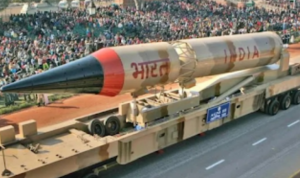
India’s nuclear arsenal was estimated at about 190 warheads in January 2026, according to the Stockholm International Peace Research Institute. The estimate placed India among the nine nuclear-armed states recognised in global arms-control studies.
India’s Nuclear Force Structure
India maintains a declared policy of minimum credible deterrence and a no-first-use posture in its official nuclear doctrine. Its nuclear delivery systems include aircraft, land-based ballistic missiles, and sea-based platforms. India has continued work on longer-range delivery systems in 2025, with missile development linked to targets across China. The force structure also includes efforts to improve survivability through mobility, concealment, and sea-based deployment.
Ballistic Missiles and MIRV Capability
India is pursuing multiple independently targetable re-entry vehicles, or MIRVs, for ballistic missiles. MIRVs allow a single missile to carry several warheads that can strike separate targets. India has also moved towards canisterised missiles, which are stored and launched from sealed containers. Canisterisation supports quicker launch preparation and better protection of missile systems during storage and transport.
Sea-Based Deterrence and SSBNs
India has a nuclear-powered ballistic missile submarine, or SSBN, as part of its sea-based deterrent. An SSBN is a submarine designed to carry ballistic missiles with nuclear warheads. SIPRI estimated that India may have begun deploying a small number of warheads on a single SSBN for occasional deterrence patrols by January 2026. Sea-based deployment forms the third leg of the nuclear triad, alongside land and air delivery systems.
India-Pakistan Nuclear Context
India’s nuclear planning in 2025 remained influenced by its rivalry with Pakistan. India and Pakistan have both developed nuclear weapons and ballistic missile systems since the late 1990s. A brief armed conflict between India and Pakistan took place in early 2025, and both sides took steps to avoid nuclear escalation. The India-Pakistan nuclear equation remains a central factor in South Asian security studies.
Important Facts for Exams
- SIPRI stands for the Stockholm International Peace Research Institute, which is based in Stockholm, Sweden.
- India conducted its first nuclear test, Pokhran-I, in 1974.
- India declared itself a nuclear-weapon state after the Pokhran-II tests in 1998.
- SSBNs are a key component of the nuclear triad used by several nuclear powers, including India.
Global Nuclear Inventory
The global nuclear inventory stood at 12,187 warheads in January 2026, with 9,745 warheads in military stockpiles. The nine nuclear-armed states include the United States, Russia, China, France, the United Kingdom, India, Pakistan, Israel, and North Korea.
| Related | |
|---|---|