India commissions first geothermal wells in Puga Valley of Ladakh
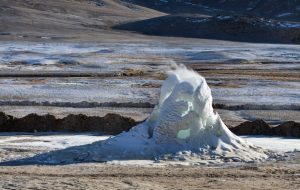
India commissioned its first and deepest geothermal wells in the Puga Valley of Ladakh on 17 July 2026. Lieutenant Governor of Ladakh V.K. Saxena inaugurated two wells drilled to a depth of 1,000 metres each at an altitude of more than 14,000 feet.
Geothermal Energy in India
Geothermal energy is heat derived from the Earth’s interior and is used for electricity generation and direct heating applications. India has identified geothermal resource zones in regions such as Ladakh, Himachal Pradesh, Uttarakhand, Gujarat, and the Andaman and Nicobar Islands.
Puga Valley Project Details
The Puga Valley project includes two geothermal wells executed by the ONGC Energy Centre. The first well reached its target depth of 1,000 metres on 22 May 2026, and the second well was spudded on 3 June 2026 and completed on 8 July 2026. A maximum temperature of 135 degrees Celsius was recorded at a depth of 400 metres in the wells. Further testing is underway to assess higher temperatures and reservoir conditions for power generation.
1 MW Pilot Geothermal Power Project
The wells are linked to a 1 MW pilot geothermal power project at Puga. Pilot projects of this type are used to test drilling, fluid flow, temperature profiles, and power conversion systems before larger-scale deployment.
Administrative and Technical Context
The project had earlier faced delays after the expiry of a memorandum of understanding between the Ladakh administration, the Ladakh Autonomous Hill Development Council-Leh, and the ONGC Energy Centre. The memorandum was renewed for five years in June 2026 after intervention by the Lieutenant Governor.
Important Facts for Exams
- Geothermal wells tap underground heat, steam, and hot water for energy use.
- Puga Valley is one of India’s best-known geothermal fields in the Union Territory of Ladakh.
- ONGC Energy Centre is the research and development arm associated with geothermal drilling in this project.
- Ladakh is often linked with renewable energy planning because of its high solar potential and cold desert climate.
Exam-Relevant Points
Geothermal power is classified as a renewable energy source under non-conventional energy systems. Ladakh’s high-altitude terrain and cold climate make it a relevant location for testing geothermal-based energy solutions.
| Related | |
|---|---|