Supreme Court on Casteist Remarks Inside Private House
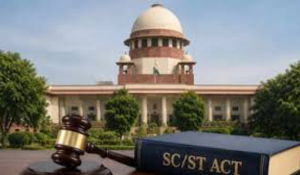
The Supreme Court of India on 11 May 2026 held that caste-based abuses made inside a private residence and outside public view do not attract the Scheduled Castes and Scheduled Tribes (Prevention of Atrocities) Act, 1989. The bench of Justice Prashant Kumar Mishra and Justice N.V. Anjaria examined the requirement of “within public view” under Sections 3(1)(r) and 3(1)(s) of the Act.
SC/ST Act and Public View Requirement
The SC/ST Act, 1989, penalises specific acts of humiliation, intimidation, and discrimination against members of Scheduled Castes and Scheduled Tribes. Sections 3(1)(r) and 3(1)(s) apply when intentional insult, intimidation, or abuse is committed in any place “within public view”. A private house can fall within public view only when members of the public can witness the incident.
Case Background and Proceedings
The case was Gunjan @ Girija Kumari vs. State of NCT of Delhi & Anr., and it arose from a property dispute in Delhi. An FIR was registered at Kirti Nagar Police Station in January 2021, and the complainant alleged casteist slurs and criminal intimidation against four family members. The Supreme Court quashed the FIR and the criminal proceedings after finding that the incident occurred inside the four walls of a house.
Earlier Judicial Position on the Issue
The Delhi High Court had declined to interfere with the trial court’s order framing charges under the SC/ST Act and Section 506 of the Indian Penal Code. The Supreme Court referred to Swaran Singh vs. State (2008), Hitesh Verma vs. State of Uttarakhand (2020), and Karuppudayar vs. State (2025) while interpreting the phrase “place within public view”.
Important Facts for Exams
- The Scheduled Castes and Scheduled Tribes (Prevention of Atrocities) Act was enacted in 1989.
- Section 3(1)(r) deals with intentional insult or intimidation with intent to humiliate a member of a Scheduled Caste or Scheduled Tribe.
- Section 3(1)(s) covers abuse of a member of a Scheduled Caste or Scheduled Tribe in any place within public view.
- Section 506 of the Indian Penal Code deals with criminal intimidation.
| Related | |
|---|---|