Scientists Find Possible Dwarf Galaxy Inside Milky Way
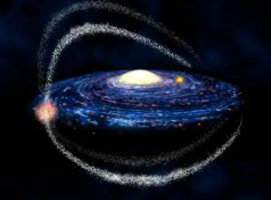
A study published in the Monthly Notices of the Royal Astronomical Society in May 2026 has proposed the existence of a hidden ancient dwarf galaxy named Loki within the Milky Way. The finding is based on chemical and orbital data from 20 metal-poor stars located within 2 kiloparsecs of the Sun.
Dwarf Galaxies in Galactic Evolution
A dwarf galaxy is a small galaxy with fewer stars and lower mass than a major galaxy such as the Milky Way. Dwarf galaxies often merge with larger galaxies during hierarchical galaxy formation, a process used in cosmology to describe the growth of galaxies through repeated mergers. The Milky Way has previously absorbed several dwarf galaxies, including Gaia-Enceladus, Sequoia, Thamnos, and Kraken. Such merger remnants are studied through stellar chemistry, orbital motion, and stellar ages.
Chemical and Orbital Evidence
The 20 stars linked to Loki show mixed orbital directions, with 11 stars on prograde orbits and 9 stars on retrograde orbits. Prograde motion means movement in the same direction as the Milky Way’s rotation, while retrograde motion means movement in the opposite direction. The stars display chemical traces associated with supernovae and neutron star mergers. They also lack signs of white dwarf activity, which is used in stellar archaeology to infer a short-lived original system.
Observational Method and Spectroscopy
The study used high-quality ESPaDOnS spectra to measure 23 chemical species in the stars. Spectroscopy is the study of light from celestial objects to determine composition, temperature, motion, and other physical properties. Matching elemental ratios across multiple stars are used in astronomy to identify a common origin. Metal-poor stars are old stars with low abundances of elements heavier than helium.
Important Facts for Exams
- The Milky Way is a barred spiral galaxy in the Local Group.
- Gaia-Enceladus is one of the best-known ancient merger remnants in the Milky Way.
- ESPaDOnS is a high-resolution spectropolarimeter used in stellar studies.
- Neutron star mergers are major sites for the formation of heavy elements such as gold and platinum.
If confirmed, Loki would add to the list of dwarf galaxies absorbed by the Milky Way. The study links stellar chemistry with galaxy merger history in the early universe.
| Related | |
|---|---|