SpaDeX Satellites Re-enter Earth’s Atmosphere Seven Hours Apart
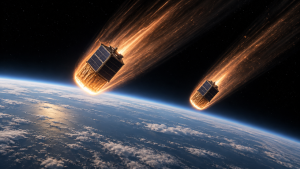
The Indian Space Research Organisation’s (ISRO) Space Docking Experiment (SpaDeX) satellites, SDX01 and SDX02, re-entered Earth’s atmosphere on 12 October 2026 in UTC, about seven hours apart. Their re-entry marked the end of a mission lasting nearly 21 months.
Space Docking and Rendezvous
Space docking is the joining of two spacecraft in orbit after they approach and align with one another. Rendezvous refers to the process by which spacecraft reach the same orbital vicinity; docking is the subsequent physical connection.
ISRO launched SDX01 and SDX02 aboard a Polar Satellite Launch Vehicle (PSLV) from Sriharikota on 30 December 2024. Each satellite weighed approximately 220 kilograms and was designed to test spacecraft approach, docking, separation and electrical power transfer.
ISRO completed the mission’s first docking on 16 January 2025. The achievement made India the fourth country to successfully demonstrate space docking, after the United States, Russia and China.
Autonomous Docking and Power Transfer
Autonomous docking uses onboard systems to guide spacecraft towards alignment and connection without continuous ground control of each manoeuvre. SpaDeX demonstrated a second autonomous docking on 20 April 2025 and transferred electrical power between the two spacecraft.
Power transfer between docked spacecraft is a capability relevant to missions involving multiple spacecraft or the assembly and operation of larger orbital structures. SpaDeX also tested the separation of the satellites after docking.
Orbital Re-entry and Mission Applications
SDX01 re-entered at 16:08 UTC on 12 October over the southern Indian Ocean, west of Australia. SDX02 followed at 23:05 UTC over the North Pacific, south of the Aleutian Islands. These UTC times correspond to 9:38 pm on 12 October and 4:35 am on 13 October in Indian Standard Time.
Space docking technology is planned for use in India’s Chandrayaan-4 lunar sample-return mission and the proposed Bharatiya Antariksh Station. Chandrayaan-4 is intended to return lunar samples to Earth, while the Bharatiya Antariksh Station is India’s proposed space station.
Important Facts for Exams
- Indian Standard Time is 5 hours and 30 minutes ahead of Coordinated Universal Time.
- The Polar Satellite Launch Vehicle is an Indian launch vehicle developed by ISRO.
- Sriharikota, in Andhra Pradesh, hosts the Satish Dhawan Space Centre.
- The Aleutian Islands form an island chain in the North Pacific, extending west from Alaska.
SDX01 and SDX02 each weighed approximately 220 kilograms. Their re-entry concluded the SpaDeX mission after demonstrations of docking, separation and electrical power transfer in orbit.
| Related | |
|---|---|