Colletes bhutanicus Found in Arunachal Pradesh
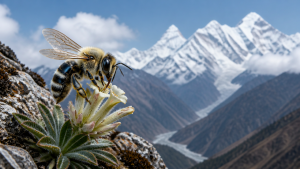
Colletes bhutanicus, a rare solitary Himalayan bee, was recorded in India for the first time in Tawang district of Arunachal Pradesh on 12 August 2026. The species was documented by scientists from the Zoological Survey of India during a survey in the Eastern Himalayas, and its first Indian record expanded its known range beyond Bhutan and China.
Taxonomy and Species Group
Colletes bhutanicus belongs to the group of solitary bees and is also called a plasterer bee. Solitary bees do not form large eusocial colonies like honeybees, and each female generally nests individually. The species was first described from Bhutan in 2003 and later recorded from high-altitude areas of China, including the Xizang region.
Distribution and Habitat
Field surveys conducted between 2019 and 2022 found the species in Tawang at elevations from 1,500 to 3,800 metres. The bee has been documented in high-altitude Himalayan habitats, which are part of the Eastern Himalayan biodiversity region. Its presence in India adds a new locality to the known distribution of the species.
Pollination and Ecological Role
The bee has been observed visiting 25 flowering plant species across 10 botanical families. These plants include mustard, buckwheat, coriander, beans, chilli, and eggplant. As a generalist pollinator, the species is associated with crop and wild plant pollination in mountain ecosystems.
Important Facts for Exams
- Colletes bhutanicus was first described in Bhutan in 2003.
- The first Indian record was made in Tawang district of Arunachal Pradesh.
- The species was published in the International Journal of Tropical Insect Science on 5 August 2026.
- Solitary bees nest individually, unlike social honeybees that live in colonies.
Scientific Significance
The species is a native Himalayan bee adapted to high-altitude conditions. It has been discussed as a climate-resilient pollinator in the Eastern Himalayas, where pollinator diversity includes both wild bees and managed honeybees.
| Related | |
|---|---|