Japan to Launch MMX Mission to Sample Phobos
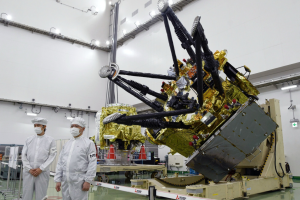
Japan Aerospace Exploration Agency (JAXA) is scheduled to launch the Martian Moons eXploration (MMX) mission on 20 October 2026, Japan Standard Time. The spacecraft will travel aboard an H3 rocket from Tanegashima Space Center and attempt to return samples from Phobos, one of Mars’s two natural satellites.
Mission Profile and Objectives
The MMX mission is planned to last about five years, with arrival in the Mars region expected around August 2027. The spacecraft is expected to spend approximately three years orbiting Phobos, collecting scientific data and preparing for sample collection. Its primary objective is to investigate how Phobos and Deimos formed and to examine their composition and geological history. The mission aims to collect at least 10 grams of material from two sites on Phobos. JAXA plans to use a coring method to obtain subsurface material, alongside a NASA-provided pneumatic sampler for surface material. The return module is scheduled to depart for Earth after sampling, with the sample capsule expected to land in Australia in 2031 before the material is transferred to Japan for analysis.
Mars and Its Natural Satellites
Phobos and Deimos are the two small natural satellites of Mars. Phobos orbits closer to Mars and completes an orbit in about 7 hours and 39 minutes, while Deimos takes about 30 hours and 18 minutes. Their origin remains unresolved; proposed explanations include the capture of asteroids and formation from material associated with Mars. The MMX spacecraft is also expected to fly past Deimos after collecting samples from Phobos and conduct observations. Comparing data from both moons can provide information about their composition and formation.
International Cooperation and Surface Exploration
MMX involves equipment and communications support from NASA, the European Space Agency (ESA), the French space agency CNES and the German Aerospace Center (DLR). A French-German rover named Idefix is planned to land on Phobos in early 2029 for a 100-day surface mission. It is intended to examine the surface and assist in identifying suitable sampling locations.
Important Facts for Exams
- Mars has two natural satellites: Phobos and Deimos.
- JAXA is Japan’s national space agency.
- The H3 is a Japanese launch vehicle used for placing spacecraft into orbit.
- The MMX sample capsule is scheduled to return to Earth in 2031.
The MMX mission’s sample-return plan includes material from two locations on Phobos. The spacecraft is also scheduled to observe Deimos during its return journey.
| Related | |
|---|---|