Scientists Study Black Forests on Planets Orbiting Two Suns
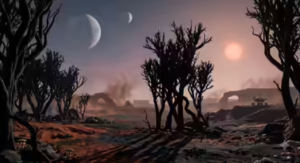
Research on extraterrestrial photosynthesis has examined how plants or microbes could evolve on planets that orbit two or three stars. The studies have considered how the colour, intensity, and ultraviolet output of starlight can affect foliage, pigments, and survival strategies on circumbinary planets.
Circumbinary Planets
Circumbinary planets are planets that orbit two stars instead of one star. Such planets are also called planets in binary star systems, and they are a recognised class of exoplanets in astronomy. In April 2011, Jack O’Malley-James of the University of St Andrews in Scotland presented a study at the Royal Astronomical Society’s national meeting in Llandudno, Wales. The study examined Earth-like planets around two or three stars and proposed that vegetation could develop black or grey foliage under some lighting conditions.
Photosynthesis and Stellar Light
Photosynthesis depends on the spectrum of light available from a star. Red dwarf stars emit dimmer light than Sun-like stars, and plants on such worlds could evolve darker leaves to absorb a wider range of visible wavelengths. On planets with two brighter Sun-like stars, organisms could evolve sunscreens to reduce ultraviolet damage. Photosynthesising microorganisms could also move in response to sudden solar flares, which are bursts of radiation from stars.
Binary Star Systems
Binary star systems contain two stars bound by gravity, and multi-star systems contain three or more stars. More than 25% of Sun-like stars and about 50% of red dwarfs are found in multi-star systems. In May 2026, astronomers confirmed 27 new potential circumbinary planets, which increased the number of known candidates for planets that orbit two stars. Research in June 2026 continued to examine how photosynthetic organisms may adapt to different lighting conditions in such systems.
Important Facts for Exams
- Black or grey foliage has been proposed for plants on planets with dim red dwarf suns.
- Circumbinary planets orbit two stars and belong to the wider category of exoplanets.
- Red dwarf stars are common in multi-star systems and are smaller and cooler than Sun-like stars.
- Solar flares are sudden releases of energy and radiation from stars.
Astrobiology and Exoplanets
Astrobiology studies the origin, evolution, and possible distribution of life in the universe. Exoplanet research includes the search for planets with conditions that may support liquid water, stable light sources, and chemical environments suitable for life.
| Related | |
|---|---|