Murchison Widefield Array Finds New Millisecond Pulsar
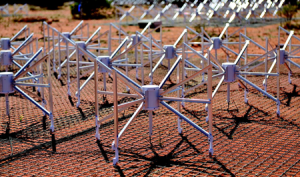
Astronomers using the Murchison Widefield Array (MWA) discovered the millisecond pulsar PSR J0125-5854 during the Southern-sky MWA Rapid Two-metre (SMART) survey. The discovery was published on the arXiv preprint server on 17 June 2026 and was accepted for publication in The Astrophysical Journal Letters.
Millisecond Pulsars
Millisecond pulsars are rapidly rotating neutron stars with spin periods below about 30 milliseconds. They are usually found in binary systems and are often studied through radio observations at low frequencies and with large radio telescopes.
PSR J0125-5854: Key Features
PSR J0125-5854 has a spin period of 24 milliseconds and a dispersion measure of 11.66 pc cm⁻³. Follow-up observations with the MWA and MeerKAT telescopes placed it in a binary system with an orbital period of more than 290 days, while current data suggest an orbital period of 833.60 ± 0.04 days.
Murchison Widefield Array and SMART Survey
The Murchison Widefield Array is a low-frequency radio telescope at the Murchison Radio-astronomy Observatory in Western Australia. It serves as a precursor to the Square Kilometre Array. The SMART survey is an ongoing pulsar search project in the southern sky at 140–170 MHz.
Important Facts for Exams
- The Murchison Widefield Array is located at the Murchison Radio-astronomy Observatory in Western Australia.
- The Square Kilometre Array is the next-generation radio astronomy project for which the MWA acts as a precursor.
- PSR J0125-5854 is the first millisecond pulsar found in the deep-pass searches of the SMART survey.
- The newly discovered pulsar lies at a Galactic latitude of -57 degrees and at an estimated distance of 0.5–1 kiloparsecs.
Survey Frequency and Search Area
The SMART survey operates in the 140–170 MHz band and targets pulsars in the southern sky. The survey is designed to identify additional pulsars through repeated low-frequency observations.
| Related | |
|---|---|