Microdroplet Chemistry Enables Catalyst-Free Skeletal Editing
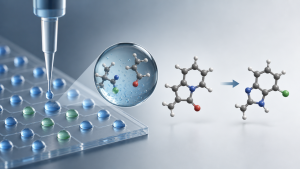
Microdroplet chemistry is a reaction approach that uses very small liquid droplets, often water microdroplets, to accelerate chemical transformations. Skeletal editing is an organic chemistry method that changes the core framework of a molecule by inserting, deleting, or swapping atoms within a ring system.
Microdroplet Chemistry
Microdroplet chemistry uses droplets at the micrometre or nanometre scale and has been studied for faster reaction rates than bulk solution chemistry. In June 2026, a team led by Shibdas Banerjee at the Indian Institute of Science Education and Research, Tirupati, used water microdroplets for catalyst-free skeletal editing. The method converted aniline into pyridine without added catalyst. Purdue University chemist Graham Cooks and researchers at Aston Labs also described a microdroplet method in June 2026 that accelerated chemical reactions without high temperatures or catalysts. Such methods are studied in green synthesis because they can reduce energy use and reagent load.
Skeletal Editing in Organic Chemistry
Skeletal editing is a branch of organic synthesis that modifies the molecular scaffold rather than only changing side chains. It includes atom insertion, atom deletion, ring expansion, ring contraction, and heteroatom replacement. These transformations are used in late-stage functionalisation and molecular diversification. Nitrogen-containing heterocycles are common drug motifs, and more than 80% of small-molecule drugs approved by the US Food and Drug Administration between 2013 and 2023 contained such structures. Skeletal editing methods are used to access pyridines, quinolines, and related ring systems from simpler precursors.
Recent Research Milestones
In March 2026, Richmond Sarpong discussed skeletal editing methods in the context of drug discovery and late-stage molecular modification. In November 2025, skeletal editing was extended to the single-molecule scale through tip-induced chemistry on bilayer sodium chloride films, where oxygen deletion and ring contraction were achieved. By December 2024, skeletal editing had been described as a new paradigm in organic chemistry, with growing work on atom insertion and deletion. Professor Mark Levin’s group reported a carbon-to-nitrogen site-directed swap in aromatic rings, and BioAscent used ring expansion to synthesise a bromo-substituted quinoline from an indole in one step in September 2024.
Important Facts for Exams
- Aniline is an aromatic amine with the formula C6H5NH2.
- Pyridine is a six-membered aromatic heterocycle containing one nitrogen atom.
- Quinoline is a fused bicyclic heterocycle used in medicinal chemistry.
- The US Food and Drug Administration regulates approval of small-molecule drugs in the United States.
| Related | |
|---|---|