India Records 7.7% GDP Growth in FY26
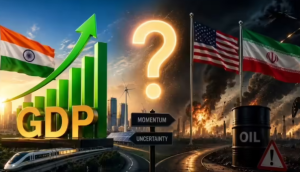
India’s Gross Domestic Product (GDP) grew by 7.7% in Fiscal Year 2025-26, and the economy expanded by 7.8% in the fourth quarter of FY26 from January to March 2026. The Reserve Bank of India (RBI) lowered its GDP growth forecast for FY27 to 6.6% and raised its inflation forecast for FY27 to 5.1% on 5 June 2026.
Gross Domestic Product and Gross Value Added
Gross Domestic Product measures the market value of all final goods and services produced within a country during a specific period. Real Gross Value Added (GVA) measures economic activity excluding taxes and subsidies, and it grew by 7.9% in FY26.
RBI Monetary Policy Committee
The RBI Monetary Policy Committee consists of six members and decides the policy repo rate under the Reserve Bank of India Act, 1934. On 5 June 2026, the MPC kept the repo rate unchanged at 5.25% and retained a neutral policy stance.
Sectoral Drivers and Forecasts
India’s FY26 growth was supported by domestic demand, investment activity, manufacturing, construction, and services. The RBI revised its FY27 growth projection from 6.9% in April to 6.6% in June 2026 because of West Asia conflict risks, energy prices, supply disruptions, and weather-related uncertainties.
Important Facts for Exams
- GDP is a key macroeconomic indicator used to measure the size of an economy.
- Real GVA excludes taxes and subsidies from the calculation of economic output.
- The repo rate is the rate at which the RBI lends short-term funds to commercial banks.
- The RBI uses a neutral stance when it does not signal a bias towards tightening or easing policy.
Inflation and Policy Context
The RBI raised its FY27 inflation forecast to 5.1% from 4.6% in April 2026. Food price uncertainty and second-round effects were listed among the factors linked to the revised inflation outlook.
| Related | |
|---|---|