India Begins Red List Assessment of 1,211 Bird Species
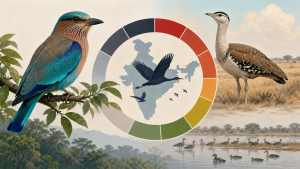
India has begun a national Red List Assessment of 1,211 regularly occurring bird species, including resident and migratory birds. The assessment follows the International Union for Conservation of Nature (IUCN) framework. As of 19 October 2026, preliminary assessments had been completed for 107 species; preliminary work on all 1,211 is expected by the end of 2026, with final assessments anticipated by the end of 2027.
IUCN Red List categories
The IUCN Red List of Threatened Species, established in 1964, records the global extinction risk and conservation status of species. Its categories include Extinct, Extinct in the Wild, Critically Endangered, Endangered, Vulnerable, Near Threatened, Least Concern, Data Deficient and Not Evaluated. Critically Endangered, Endangered and Vulnerable are the three categories collectively classified as threatened.
Preliminary assessments proposed the Great Indian Bustard as Critically Endangered and the Indian Roller as Vulnerable. The Grey Plover was proposed as Least Concern, while the Marbled Duck, White-throated Bushchat and Pallas’s Fish-Eagle were proposed as Endangered. The Sarus Crane was proposed as Vulnerable. These are proposed national assessment outcomes, not final assessments.
Evidence used in species assessment
Red List assessments use evidence relating to geographic range, population size and population trends. India’s bird assessment is being carried out by the Zoological Survey of India, the IUCN SSC Center for Species Survival India–Wildlife Trust of India and the State of India’s Birds initiative. The latter uses citizen-science data to assess population trends in many widespread and common bird species. Population-size estimates remain unavailable for most Indian bird species.
National Red List Roadmap
India launched its National Red List Roadmap and Vision 2025–2030 at the IUCN World Conservation Congress 2025 in Abu Dhabi. The roadmap sets a target of assessing more than 11,000 species of flora, fauna and fungi by 2030. The Union Environment Ministry spearheads the initiative, with the Botanical Survey of India, Zoological Survey of India, IUCN India and the IUCN SSC Center for Species Survival India–Wildlife Trust of India among the collaborating organisations.
Important Facts for Exams
- The IUCN Red List of Threatened Species was established in 1964.
- Critically Endangered, Endangered and Vulnerable are the IUCN Red List’s threatened categories.
- India’s National Red List Roadmap aims to assess more than 11,000 species by 2030.
- Geographic range, population size and population trends are key evidence parameters in species assessments.
The national bird assessment covers 1,211 regularly occurring species, including migratory and resident birds. The proposed conservation categories remain subject to completion of the final assessment.
| Related | |
|---|---|