Great Indian Bustard Chick Survives in Gujarat
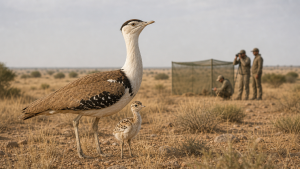
The Great Indian Bustard (Ardeotis nigriceps) is a critically endangered bird species found mainly in the Thar desert of Rajasthan, with fewer than 150 birds left in the wild. A second chick produced through the “jumpstart” technique in Naliya, Kutch district, Gujarat, survived beyond the critical 40-day period after hatching on 21 May 2026.
Great Indian Bustard Conservation in India
The Great Indian Bustard is one of India’s heaviest flying birds and is listed as Critically Endangered on the IUCN Red List. Its main wild population survives in Rajasthan, especially in desert grassland habitats, and smaller numbers occur in Gujarat.
Captive Breeding and Jumpstart Technique
The “jumpstart” technique involves moving a fertile, captive-bred Great Indian Bustard egg from Rajasthan to Gujarat and placing it under a wild female for incubation and chick rearing. This method addresses the problem of infertile eggs laid by the three remaining wild females in Gujarat. The first jumpstart chick hatched on 26 March 2026 in the Naliya grasslands and went missing in April 2026, with predation suspected as a possible cause. The second chick’s survival beyond 40 days is a key milestone in the breeding programme.
Conservation Breeding Centres and Rewilding
The conservation breeding centres at Sam and Ramdevra in Rajasthan held 98 Great Indian Bustards as of 9 July 2026. During the 2026 breeding season, 26 chicks had hatched through artificial insemination, natural breeding, and wild-collected eggs. The Project Great Indian Bustard is a collaborative programme involving the Union Environment Ministry, the Wildlife Institute of India, and the forest departments of Rajasthan and Gujarat. Union Environment Minister Bhupender Yadav stated on 9 July 2026 that the project will soon enter its rewilding phase.
Important Facts for Exams
- The Great Indian Bustard is the state bird of Rajasthan.
- The species is protected under the Wildlife (Protection) Act, 1972.
- The Great Indian Bustard is among the most endangered birds in India.
- Desert grasslands and open scrub habitats are important for its survival.
Distribution and Habitat
The Great Indian Bustard is associated with arid and semi-arid landscapes, including grasslands, scrublands, and desert plains. Rajasthan remains the main stronghold of the species, while Gujarat has a smaller conservation population.
| Related | |
|---|---|