UNESCO Adds Three Indian Manuscripts to Asia-Pacific Register
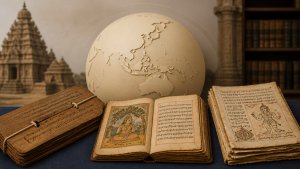
On 5 November 2026, manuscripts of the Mahabharata, Rajatarangini and Arthashastra were inscribed on the UNESCO Memory of the World Asia-Pacific Regional Register. The decision was taken at the 11th Session of the Memory of the World Committee for Asia and the Pacific (MOWCAP), held in Jakarta, Indonesia, from 2 to 6 November.
Manuscripts and their repositories
The Mahabharata manuscript, written in Sharada script on birch bark (burjapatra) and about 400 years old, is held at the Bhandarkar Oriental Research Institute in Pune. The complete 16th-century palm-leaf manuscript of Kautilya’s Arthashastra, written in Grantha script, is preserved at the Oriental Research Institute in Mysuru. Kalhana’s 12th-century Rajatarangini manuscript is held at the Oriental Research Library, Sri Pratap Singh Library Complex, Srinagar.
Register additions
The Indira Gandhi National Centre for the Arts prepared the nomination dossiers for all three works. Union Culture Minister Gajendra Singh Shekhawat welcomed the inscriptions as recognition of India’s documentary and civilisational heritage. The additions bring India’s total on the Asia-Pacific Regional Register to six. At the session, 21 items were added from 28 documentary heritage nominations submitted by 26 countries for the 2025–2026 cycle.
Important Facts for Exams
- State regulation: The Arthashastra describes private and state enterprises competing under common regulation, while reserving some economic activities as state monopolies.
- Historical corroboration: The Rajatarangini begins aligning with other historical evidence only in Book 4, its account of the Karkota dynasty.
- Regional register distinction: MOWCAP is one of UNESCO’s regional committees in its Memory of the World Programme; its Asia-Pacific register is separate from the programme’s international register.
- Manuscript collation: The Bhandarkar Oriental Research Institute’s Critical Edition of the Mahabharata was produced by collating manuscript witnesses gathered from across India and beyond.
| Related | |
|---|---|