Kerala’s Mangrove Cover Expanded Over the Past Decade
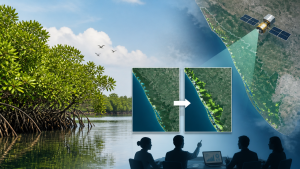
A study by the ICAR-Central Marine Fisheries Research Institute (CMFRI) found an overall increase in mangrove cover across Kerala’s coastal districts over the past decade. Presented at an international symposium in Kochi on 6 November 2026, it compared satellite images from 2017 and 2026. The increase came after Kerala lost nearly 90% of its mangroves over the preceding five decades.
Study and symposium
The three-day symposium on fisheries and remote sensing was jointly organised by the Trevor Platt Science Foundation, the Department of Chemical Oceanography at the Cochin University of Science and Technology, CMFRI and the Marine Biological Association of India. The study used satellite-based monitoring to track changes in mangrove vegetation.
Mangroves provide breeding and nursery grounds for fish, help protect coastlines from cyclones and storm surges, and absorb atmospheric carbon.
Important Facts for Exams
- Root salt filtration: Mangroves withstand saline water through root salt filtration and root systems adapted to immersion and wave action.
- Viviparous germination: Many mangroves are viviparous, with seeds germinating while attached to the parent tree rather than first germinating in soil.
- Time-series revisit: For time-series monitoring, temporal resolution describes how frequently a satellite or aircraft revisits an area.
| Related | |
|---|---|