Types of Industrial Waste and Their Utilisation in India
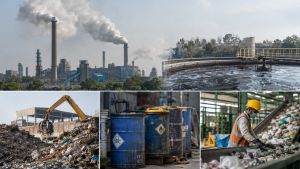
Industrial waste includes solid, liquid and gaseous byproducts from industrial activity. Managing these materials through reduction, reuse, recycling and resource recovery can limit environmental harm and support a circular economy and more sustainable industrial growth in India.
Types and Sources of Industrial Waste
Industrial waste is classified by its source, composition and hazard potential. Its safe management depends on identifying its properties and selecting suitable treatment, recovery or disposal methods.
- Hazardous waste: Has properties such as toxicity, corrosivity, ignitability or reactivity that can threaten human health or the environment. Examples include chemical sludges, spent solvents and wastes containing heavy metals.
- Non-hazardous waste: Does not exhibit hazardous characteristics. Examples include fly ash, blast furnace slag, construction and demolition waste, and some organic processing residues.
- Sector-specific streams: Metallurgical industries produce slags, red mud and dross; chemical industries generate spent acids, alkalis and residues; thermal power plants produce fly ash, bottom ash and pond ash. Textile and food-processing industries generate dyeing or treatment sludge, fabric scraps, organic residues and packaging waste.
Legal and Institutional Framework
India’s industrial waste framework operates primarily under the Ministry of Environment, Forest and Climate Change. The Environment (Protection) Act, 1986, provides broad powers for environmental protection and waste management.
- Hazardous and Other Wastes Rules, 2016: The Hazardous and Other Wastes (Management and Transboundary Movement) Rules, 2016, regulate the generation, collection, storage, transport, import, export and disposal of covered wastes. Generators are responsible for proper management from generation to final disposal, reflecting the cradle-to-grave principle.
- Other waste rules: The Solid Waste Management Rules, 2016, may apply to certain industrial non-hazardous wastes or require integrated management. The Plastic Waste Management Rules, 2016, amended in 2021, address plastic waste, while the E-Waste (Management) Rules, 2016, provide for Extended Producer Responsibility.
- Regulatory bodies: The Central Pollution Control Board (CPCB) and State Pollution Control Boards (SPCBs) implement and enforce rules, monitor pollution and issue guidelines.
Major Waste Streams and Their Uses
Many industrial residues can substitute for virgin materials or provide recoverable resources. Their use depends on composition, processing requirements and applicable safety and quality controls.
- Fly ash: Generated in large quantities by coal-fired thermal power plants. It is used in cement, bricks and blocks, road construction and mine-void filling.
- Blast furnace slag: Granulated blast furnace slag is used in Portland slag cement (PSC), reducing the need for clinker. Slag is also used as aggregate in concrete and road construction.
- Steel slag: India generates about 19 million tonnes annually, with production projected to reach 60 million tonnes by 2030. Steelmaking typically produces around 150–200 kilograms of slag per tonne of steel, with some estimates reaching 250 kilograms.
- Other residues: Red mud, or bauxite residue, is highly alkaline; potential uses include cement and construction materials, rare earth element recovery and soil amelioration after neutralisation. Phosphogypsum from phosphoric acid production may be used in cement, plaster and soil conditioners, but potential radioactivity requires careful processing and regulation.
Methods of Waste Utilisation
Industrial waste utilisation turns suitable residues into materials, products or energy, while reducing reliance on virgin resources and limiting disposal needs.
- Material substitution: Processed fly ash and slag can replace some inputs in cement; steel slag can serve as road aggregate, and construction and demolition waste can be incorporated into new building materials.
- Energy recovery: Incineration with energy recovery, gasification and pyrolysis can convert suitable waste into usable energy. These methods are relevant to high-calorific-value, non-recyclable wastes.
- Cement-kiln co-processing: Wastes with suitable calorific value or chemical composition can be used as supplementary fuel or raw material. The process combines energy recovery with material use; high kiln temperatures can destroy pollutants in suitable waste streams.
- Recovery and biological treatment: Metals can be recovered from electronic waste and valuable elements from industrial residues. Biological treatment, including composting and bioremediation, can process some organic wastes; suitable residues may also be used to produce biogas.
Steel Slag in Roads and Other Applications
Steel slag includes material from Basic Oxygen Furnace (BOF) and Electric Arc Furnace (EAF) processes. Differences in feedstocks and refining conditions give these slags distinct compositions, so each requires separate assessment before use as aggregate. Fresh slag may contain free calcium and magnesium oxides that hydrate and expand. Ageing or other stabilisation is therefore needed before use as a dimensionally stable aggregate. Steel slag is generally denser than conventional mineral aggregate, which can increase pavement-layer mass and transport loads.
- Road construction: Scientifically processed steel slag can replace natural aggregate. The six-lane bituminous road connecting NH-6 to Hazira port in Surat, Gujarat, used about 1 lakh tonne of processed steel slag, replacing natural aggregates in all layers. It is recognised as the world’s first steel slag road.
- Pothole repair: ECOFIX® is an iron- and steel-slag-based instant repair mix designed for use even in wet conditions. RAMUKA GLOBAL SERVICES, a DPIIT-recognised startup, commercialised it under a technology licence from CSIR-CRRI.
- Other uses: Steel slag can be used as a raw material in cement, as railway ballast and, in some cases, as a soil conditioner because of its liming properties.
Key Prelims Takeaways
- The Hazardous and Other Wastes (Management and Transboundary Movement) Rules, 2016, cover hazardous and other wastes.
- CPCB and SPCBs are key bodies for pollution monitoring and enforcement.
- Fly ash is used in cement, bricks, blocks, roads and mine-void filling; blast furnace slag is used in Portland slag cement.
- Steel slag generation in India is about 19 million tonnes annually and is projected to reach 60 million tonnes by 2030.
- Fresh steel slag may require stabilisation; BOF and EAF slags need separate assessment for aggregate suitability.
- The Hazira road and ECOFIX® illustrate steel slag use in infrastructure and pothole repair.
Recent Context
On November 26, 2026, CSIR-CRRI received the CII 4R Awards 2026 for its steel slag-based road technologies and ECOFIX®. It won in the research-labs and academic-institutions category and was also recognised among India’s Top 30 Waste-to-Worth Leaders.
| Related | |
|---|---|