South Korea’s KSTAR Sustains Plasma for 102 Seconds
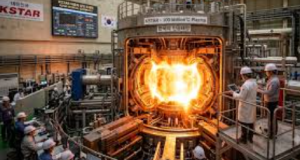
KSTAR, or the Korea Superconducting Tokamak Advanced Research device, sustained plasma in high-confinement mode for 102 seconds during experiments conducted from December 2023 to February 2024. The same experimental campaign recorded plasma at ion temperatures of 100 million degrees Celsius for 48 seconds, which set a new KSTAR record.
KSTAR and Tokamak Basics
KSTAR is a superconducting tokamak located in Daejeon, South Korea, and it is operated by the Korea Institute of Fusion Energy. A tokamak is a magnetic confinement device used in fusion research to contain plasma in a toroidal chamber.
High-Confinement Mode and Plasma Conditions
High-confinement mode, or H-mode, is a plasma operating regime first identified in tokamak experiments in 1982. It is used in fusion research because it allows improved confinement of heat and particles inside the plasma. Plasma at 100 million degrees Celsius is a standard target temperature in magnetic fusion experiments involving deuterium-tritium fuel. KSTAR’s earlier record for maintaining 100 million degrees Celsius plasma was 30 seconds in 2021.
Divertors and Heat Management
KSTAR received upgrades in 2023, including replacement of its divertors with tungsten components. A divertor is a plasma-facing component in a tokamak that removes heat, impurities, and exhaust particles from the edge of the plasma. Tungsten has a very high melting point of 3,422 degrees Celsius and is used in fusion devices for its heat-resistant properties. In the KSTAR campaign, the tungsten divertors showed only a 25% increase in surface temperature under similar heat loads compared with older carbon-based components.
Important Facts for Exams
- KSTAR stands for Korea Superconducting Tokamak Advanced Research.
- KSTAR is operated by the Korea Institute of Fusion Energy in Daejeon, South Korea.
- H-mode was first observed in 1982 in tokamak plasma experiments.
- Tungsten is widely used in fusion research because of its high melting point and heat tolerance.
Fusion Research Target
KSTAR’s long-term target is to sustain high-performance plasma for 300 seconds. The 102-second H-mode operation and the 48-second 100 million degrees Celsius plasma are milestones in long-pulse fusion research.
| Related | |
|---|---|