Mount Erebus Gold Crystals
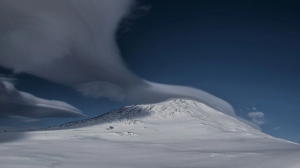
Mount Erebus is an active volcano on Ross Island in East Antarctica, about 1,350 kilometres from the South Pole. It is the southernmost active volcano on Earth and has been continuously erupting since 1972. The volcano releases microscopic crystals of elemental gold into the atmosphere, and the crystals can travel up to 1,000 kilometres from the volcano.
Mount Erebus: Location and Volcanic Status
Mount Erebus rises on Ross Island in the Ross Sea region of Antarctica. It is one of the few volcanoes on Earth with a permanent lava lake, and it remains in a state of persistent volcanic activity.
Gold Crystal Emission
The volcano is reported to emit about 80 grams of gold each day. This quantity is valued at about 6,000 US dollars per day and about 2.19 million US dollars per year. The gold occurs as microscopic crystals that can measure up to about 60 micrometres across.
Scientific Study of the Phenomenon
The gold-crystal phenomenon was first documented in a 1991 paper in Geophysical Research Letters. The study included geochemist Kimberly Meeker of the New Mexico Institute of Mining and Technology. Scientists have not established a single confirmed mechanism for the formation of these crystals.
Important Facts for Exams
- Mount Erebus is the southernmost active volcano on Earth.
- Mount Erebus has been continuously erupting since 1972.
- Geophysical Research Letters is a peer-reviewed scientific journal that publishes geoscience research.
- Micrometre is a unit equal to one-millionth of a metre.
Formation Theories and Uniqueness
One theory links the crystals to volatile chlorine- or sulfur-bearing compounds that cool and crystallise. Another theory places crystal formation on the surface of the permanent lava lake before atmospheric transport. Mount Erebus is the only known volcano that consistently emits crystals of elemental gold.
Recovery and Distribution
The crystals are dispersed by air currents across remote Antarctic ice. Their microscopic size and wide spread make recovery impractical and economically unviable.
| Related | |
|---|---|