Important Religious Festivals and National Observances in Bhutan
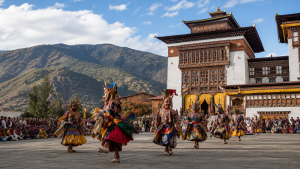
Bhutan’s religious festivals and national observances reflect its Buddhist traditions, royal history and distinctive cultural identity. Their calendars bring together religious practice, public life and remembrance, while festivals such as Tshechu also make Bhutanese culture visible to visitors.
Important Religious Festivals
Bhutan’s religious calendar is predominantly Buddhist and closely associated with the Drukpa Kagyu tradition. Festivals commonly include prayers, offerings and masked dances, linking religious devotion with community life.
- Lhabab Duchen: Observed on November 1, 2026, it commemorates Buddha Shakyamuni’s descent from Trāyastriṃśa Heaven after teaching the Dharma to the gods and liberating his mother from samsara. It is one of the four major Buddhist festivals; virtuous actions are believed to multiply many times over on this day.
- Tshechus: Annual festivals held in each dzongkhag on the tenth day of a lunar month honour Guru Rinpoche (Padmasambhava), who introduced Tantric Buddhism to Bhutan in the 8th century. They feature religious ceremonies and masked dances.
- Major Tshechus: Paro Tshechu is a spring festival, usually held in March or April. Thimphu Tshechu, the largest, lasts three days and is scheduled for September 13–15 in 2026. Punakha and Trongsa hold significant local festivals; Jakar Tshechu takes place at Jakar Dzong in Bumthang, while Wangdue Phodrang Tshechu is known for local songs and ornamental speeches.
- Losar: The Lunar New Year is celebrated between February and March and typically lasts 15 days. In 2026, it falls on February 17.
- Buddhist holy days: The 2026 observances include Guru Rinpoche’s birth anniversary on July 10, Parinirvana Day on July 17, and Drukpa Tshezhi, commemorating Buddha’s first sermon, on July 26.
- Dashain: Usually observed in September or October, it is the main Hindu festival for Bhutan’s Nepalese population.
- Black-necked Crane Festival: Held annually at Gangtey Monastery on November 11, it raises awareness of black-necked crane conservation. The 2026 observance is scheduled for that date.
Important National Observances
National observances commemorate Bhutan’s monarchy, historical milestones and figures associated with the country’s formation. Several dates also intersect with religious or constitutional significance.
- National Day (Gyalyong Duechen): Observed on December 17, it marks the 1907 coronation of Ugyen Wangchuck as Bhutan’s first Druk Gyalpo. The event is associated with the unification of the country.
- Traditional Day of Offering (Buelwa Phuewi Nyim): Observed on January 28, 2026, it is a day of thanksgiving to Zhabdrung Ngawang Namgyal, regarded as Bhutan’s founder.
- Royal birthdays: The birth anniversary of the 5th King, Jigme Khesar Namgyel Wangchuck, is observed from February 21 to 23 in 2026. The birth anniversary of the 3rd King, Jigme Dorji Wangchuk, falls on May 2.
- November observances: November 1, 2026, marks the public holiday for the coronation of the 5th Druk Gyalpo and is also observed as Mother’s Day and Lhabab Duchen. The formal coronation took place on November 6, 2008. November 11 marks the birth anniversary of the 4th King, Jigme Singye Wangchuck, and Constitution Day.
- Other observances: Nyinlong, the winter solstice, is observed on January 2 and is considered propitious. Zhabdrung Kuchoe, a national day of mourning for Zhabdrung Ngawang Namgyal, typically falls in April or May.
Buddhist Stupas and Chortens
Buddhist stupas, known in Bhutan as Jangchub Chortens, are revered monuments in the country’s religious landscape. Their forms and devotional use connect Bhutanese practice with wider Buddhist traditions.
- Stupas may be relic, object, commemorative, symbolic or votive monuments, depending on what they enshrine or commemorate.
- Pradakhshina is the clockwise circumambulation of a stupa, a longstanding Buddhist devotional ritual.
- In Tibetan Buddhism, the stupa developed into the chorten, the term used for this monument in Tibet and Bhutan. The traditional South Asian form has a solid dome above a drum, usually on a square base, and no access to its interior.
Key Figures and Cultural Significance
Guru Rinpoche, also known as Padmasambhava, is central to Tshechu festivals and is credited with bringing Buddhism to Bhutan. Zhabdrung Ngawang Namgyal unified the country in the 17th century and established its distinct Drukpa Kagyu identity. The title Druk Gyalpo means “Dragon King” and is used for the King of Bhutan. A dzongkhag is an administrative and judicial district, with a central dzong serving as a religious and administrative headquarters. Festivals and observances sustain cultural identity and show how religion and society intersect in Bhutanese public life. Tshechu performances and the country’s Buddhist heritage also contribute to Bhutan’s cultural soft power.
Key Prelims Takeaways
- Lhabab Duchen commemorates Buddha’s descent from Trāyastriṃśa Heaven.
- Tshechus honour Guru Rinpoche and are held on the tenth day of a lunar month.
- Thimphu Tshechu is Bhutan’s largest Tshechu; Losar is the Lunar New Year.
- December 17, National Day, marks Ugyen Wangchuck’s 1907 coronation as the first Druk Gyalpo.
- November 11 is both Constitution Day and the birth anniversary of the 4th King.
- Jangchub Chortens are Buddhist stupas; pradakhshina is their clockwise circumambulation.
Recent Context
On November 1, 2026, 108 Buddhist stupas, or Jangchub Chortens, were constructed and consecrated in one day at Gelephu Mindfulness City. The record was recognised by Guinness World Records on November 3, coinciding with the 5th King’s 18th coronation anniversary, Lhabab Duchen and Mother’s Day.
| Related | |
|---|---|