Dung Beetles Use Milky Way for Night Navigation
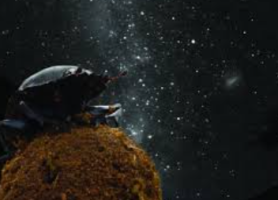
Dung beetles have shown one of the most surprising navigation abilities in the animal kingdom—they use the Milky Way to move in straight lines at night. Scientists found that these tiny insects can orient themselves using the bright band of stars in the night sky, making them the first known animals to use the Milky Way for navigation. This discovery has provided important insights into animal behaviour and celestial orientation.
Why Straight-Line Movement Is Important
Dung beetles depend on animal droppings for food and reproduction. Once they find dung, they quickly shape it into a ball and roll it away from the dung pile. This behaviour helps them avoid competition from other beetles, many of which try to steal ready-made dung balls instead of making their own.
Moving in a straight line is critical. If a beetle gets distracted or loses direction, it risks losing its dung ball and must start again. This wastes time and energy and reduces its chances of successful reproduction.
How They Navigate During the Day
During daylight, dung beetles use the Sun to guide themselves. They detect special patterns of polarised light around the Sun, which are invisible to humans. Their eyes contain unique receptors that allow them to sense these patterns.
By maintaining a fixed angle to this light, the beetles can roll their dung balls in a straight path. This efficient system helps them escape crowded dung piles quickly.
Using the Milky Way at Night
At night, sunlight-based navigation becomes impossible. Moonlight can sometimes help, but it is not always available or bright enough. Scientists studying nocturnal species like Scarabaeus satyrus found that these beetles still travelled accurately even on moonless nights.
Experiments in open skies and planetariums showed that beetles remained well-oriented when they could see the star-filled sky. Even when shown only the bright band of the Milky Way, they continued to move correctly. This proved they were using the galaxy itself as a guide.
Important Facts for Exams
- Dung beetles are the first known animals found to use the Milky Way for navigation.
- Polarised light around the Sun helps many insects navigate during daytime.
- The Milky Way appears as a bright band of stars visible in dark night skies.
- Scarabaeus satyrus is a nocturnal dung beetle species used in navigation studies.
Experiments Confirm Sky-Based Orientation
To confirm the role of celestial cues, scientists placed tiny caps on the beetles’ heads so they could not see the sky. Once deprived of this visual access, the insects lost their straight-line movement and wandered randomly.
This proved that their navigation depends strongly on visual signals from the sky rather than only on ground-based clues. The finding highlights how even small insects can possess highly advanced survival strategies shaped by evolution.
| Related | |
|---|---|