Chinese Team Creates Record-Cold Rubidium Bose-Einstein Condensate
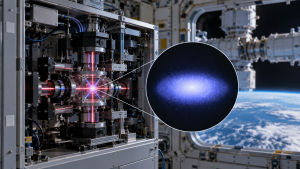
Chinese researchers cooled rubidium atoms aboard the Tiangong space station to a record-low 9.7 picokelvins, or 9.7 trillionths of a kelvin above absolute zero. The achievement, dated 7 November 2026, surpassed previous US and German records.
Experiment in orbit
Teams from Peking University and the Chinese Academy of Sciences, led by physicists Xiaoji Zhou, Xuzong Chen and Weibiao Chen, used the station’s Cold Atom Physics Rack. They formed a Bose-Einstein condensate (BEC) from thousands of rubidium atoms using optical dipole traps. The laser-only trapping setup differed from experiments that rely on magnets.
About 20,000 atoms formed the final ultracold cloud, which remained visible for seven seconds after release. The measured temperature was described as about 280 billion times colder than deep space’s background temperature. The experiment was published in Science around 5 November; this date precedes the stated 7 November achievement, leaving the sequence unclear.
Researchers identify quantum simulations, precision measurements, ultra-precise space sensors and tests of fundamental physics, including Einstein’s theory of gravity, as potential applications.
Important Facts for Exams
- Macroscopic quantum state: In a Bose–Einstein condensate, many bosons occupy the lowest quantum state, making microscopic quantum effects such as wavefunction interference visible macroscopically.
- Optical-trap force: Optical dipole traps confine neutral atoms through AC Stark shifts; red-detuned light draws them towards intensity maxima, whereas blue-detuned light pushes them towards minima.
- Microgravity measurements: Microgravity reduces gravitational sag and permits longer free expansion of ultracold clouds, enabling more precise measurements of atomic interactions and inertial forces.
- Rubidium-87 cooling transition: Rubidium-87 is a bosonic isotope; its 780-nanometre D2 optical transition enables efficient laser cooling and trapping.
| Related | |
|---|---|